

[Apr 14, 2026] 100% Real & Accurate ACP-120 Questions with Free and Fast Updates
Self-Study Guide for Becoming an Jira Cloud Administrator Expert
The Atlassian ACP-120 (Jira Cloud Administrator) Certification Exam is a comprehensive assessment designed to test the skills and knowledge of professionals who are responsible for administering Jira Cloud environments. Jira Cloud Administrator certification exam is a valuable credential for IT professionals who want to demonstrate their expertise in managing Jira Cloud projects and workflows.
NEW QUESTION # 26
Your Jira cloud instance has hundreds of projects which are used only by the development team at your organization.
All projects share a single permission scheme New business requirements state:
* Customer support staff at your organization need to view all issues in all projects
* They also need to share filters with other users
* They should not be granted too much access
Identify the appropriate way to configure customer support staff in Jira (Choose one)
- A. As a new group
- B. As a new project role
- C. With an approved domain
- D. As a security level
- E. With the Trusted role
Answer: A
NEW QUESTION # 27
You were asked to modify the only workflow in a company-managed project. Which two requirements can be satisfied using only out-of-box functionality? (Choose two.)
- A. Only a subset of project users should be able to create epics.
- B. Automatically reassign an issue when Priority is edited.
- C. Automatically set Due Date based on the issue type.
- D. Automatically clear Assignee when transitioning to Pending.
- E. Only members of Testers project role can transition to Passed.
Answer: D,E
Explanation:
In a company-managed project, workflows define the statuses and transitions for issues. Modifying a workflow using out-of-box functionality involves addingconditions,validators,post functions, orproperties to transitions. The two requirements that can be satisfied using only out-of-box functionality are automatically clear Assignee when transitioning to Pending(Option C) andonly members of Testers project role can transition to Passed(Option E).
* Explanation of the Correct Answers:
* Automatically clear Assignee when transitioning to Pending (Option C):
* This requirement can be met by adding apost functionto the workflow transition to the Pendingstatus. The out-of-boxClear Field Valuepost function can be used to clear the Assigneefield during the transition.
* Exact Extract from Documentation:
Configure workflow post functions
Post functions are executed after a transition is completed and can update issue fields or perform other actions. Out-of-box post functions include:
* Clear Field Value: Clears the value of a specified field (e.g., Assignee).To add a post function:
* Go toSettings > Issues > Workflows.
* Edit the workflow and select the transition to Pending.
* Add theClear Field Valuepost function and chooseAssignee.Note: Post functions are executed automatically during the transition, requiring no additional configuration.(Source: Atlassian Support Documentation, "Configure advanced work item workflows")
* Why This Fits: TheClear Field Valuepost function is an out-of-box feature that directly clears theAssigneefield during the transition toPending, satisfying the requirement without custom scripting or apps.
* Only members of Testers project role can transition to Passed (Option E):
* This requirement can be met by adding aconditionto the workflow transition to thePassed status. The out-of-boxUser Is In Project Rolecondition can restrict the transition to members of theTestersproject role.
* Exact Extract from Documentation:
Configure workflow conditions
Conditions restrict who can execute a workflow transition. Out-of-box conditions include:
* User Is In Project Role: Allows only users in a specified project role (e.g., Testers) to perform the transition.To add a condition:
* Go toSettings > Issues > Workflows.
* Edit the workflow and select the transition to Passed.
* Add theUser Is In Project Rolecondition and select theTestersrole.Note: Conditions are evaluated before the transition is displayed, ensuring only authorized users see the option.(Source: Atlassian Support Documentation, "Configure advanced work item workflows")
* Why This Fits: TheUser Is In Project Rolecondition is an out-of-box feature that restricts thePassedtransition to theTestersproject role, satisfying the requirement without custom scripting or apps.
* Why Other Options Are Incorrect:
* Automatically set Due Date based on the issue type (Option A):
* Out-of-box post functions allow setting a field to a specific value (e.g.,Update Issue Field) but do not support conditional logic based on issue type (e.g., setting different due dates for different issue types). This requirement would require a scripted post function or an automation rule, which goes beyond out-of-box workflow functionality.
* Extract from Documentation:
Out-of-box post functions can update fields with static values (e.g., set Due Date to a specific date).
Conditional logic based on issue type requires automation rules or third-party apps.
(Source: Atlassian Support Documentation, "Configure advanced work item workflows")
* Only a subset of project users should be able to create epics (Option B):
* Creating epics is controlled by theCreate Issuespermission in the project's permission scheme, not by workflow settings. While permissions can be restricted to a subset of users (e.g., a group or role), this is not a workflow modification. Additionally, restricting epic creation specifically (versus other issue types) requires issue type-specific permissions, which are not supported out-of-box without advanced configuration or apps.
* Extract from Documentation:
TheCreate Issuespermission controls who can create issues, including epics. Issue type-specific restrictions require advanced permission schemes or apps, not workflow changes.
(Source: Atlassian Support Documentation, "Manage permissions in Jira Cloud")
* Automatically reassign an issue when Priority is edited (Option D):
* Reassigning an issue when thePriorityfield is edited is not possible with out-of-box workflow post functions, as post functions are tied to transitions, not field edits. This requirement would require a Jira automation rule or a scripted listener, which goes beyond out-of-box workflow functionality.
* Extract from Documentation:
Post functions are executed during workflow transitions, not field edits. To react to field changes like Priority, use Jira automation or third-party apps.
(Source: Atlassian Support Documentation, "Automate your Jira Cloud instance")
* Additional Notes:
* Modifying workflows requiresJira administratorprivileges, as workflows are managed at the system level (Settings > Issues > Workflows).
* Out-of-box functionality refers to native Jira features without scripting, third-party apps, or automation rules. Options C and E leverage standard post functions and conditions, while A, B, and D require additional logic or non-workflow configurations.
:
Atlassian Support Documentation:Configure advanced work item workflows
Atlassian Support Documentation:Manage permissions in Jira Cloud
Atlassian Support Documentation:Automate your Jira Cloud instance
NEW QUESTION # 28
Requirements for field behavior in a company-managed project are shown:
Issue Type
Attribute (custom field)
Epic
Hidden
Story
Optional
Bug
Required
What do you need to configure to meet the requirements?
- A. Screens
- B. Custom field contexts
- C. Field configurations
- D. Screen schemes
Answer: C
Explanation:
To meet the requirements for theAttributecustom field's behavior (hidden for Epics, optional for Stories, required for Bugs) in a company-managed project, you need to configurefield configurations(Option A).
Field configurations define whether a field is required, optional, or hidden for specific issue types.
* Explanation of the Correct Answer (Option A):
* Field configurationscontrol the behavior of fields (e.g., required, optional, hidden) for different issue types in a company-managed project. To meet the requirements:
* ForEpics, set theAttributefield toHidden.
* ForStories, set theAttributefield toOptional(not required).
* ForBugs, set theAttributefield toRequired.
* This is achieved by creating multiple field configurations (one for each issue type's behavior) and associating them with afield configuration schemethat maps configurations to issue types.
* Exact Extract from Documentation:
Configure field settings
Field configurations define whether fields are required, optional, or hidden for specific issue types. A field configuration scheme maps field configurations to issue types in a project.
To configure:
* Go toSettings > Issues > Field configurations.
* Create or edit field configurations (e.g., one for Epics, Stories, Bugs).
* For each configuration:
* Mark a field asRequiredto enforce a value.
* Mark a field asHiddento remove it from screens.
* Leave a field asOptional(default) if not required.
* Create a field configuration scheme (Settings > Issues > Field configuration schemes) and map configurations to issue types.
* Assign the scheme to the project inProject settings > Fields.Example: Hide a field for Epics, make it optional for Stories, and required for Bugs.(Source: Atlassian Support Documentation, "Configure field settings")
* Why This Fits:Field configurationsallow you to set theAttributefield as hidden, optional, or required for different issue types, directly meeting the requirements.
* Why Other Options Are Incorrect:
* Screens (Option B):
* Screens define which fields appear during issue operations (e.g., Create, Edit, View). While hiding a field on a screen for Epics could make it appear hidden, screens are not issue type- specific unless combined with ascreen scheme. Screens also cannot enforcerequiredor optionalbehavior, which is handled by field configurations.
* Extract from Documentation:
Screens control which fields are displayed but do not manage required or optional behavior. Use field configurations for field behavior.
(Source: Atlassian Support Documentation, "Configure screens in Jira Cloud")
* Custom field contexts (Option C):
* Custom field contexts define the options and default values for a custom field across projects or issue types. They do not control whether a field is hidden, optional, or required, which is managed by field configurations.
* Extract from Documentation:
Custom field contexts set options and defaults for fields, not their visibility or required status. Use field configurations for behavior.
(Source: Atlassian Support Documentation, "Manage custom fields in Jira Cloud")
* Screen schemes (Option D):
* Screen schemes map screens to issue operations (e.g., Create, Edit) for issue types. They control which fields appear on screens but do not manage whether fields are required or optional, which is handled by field configurations.
* Extract from Documentation:
Screen schemes assign screens to issue types but do not control field behavior like required or hidden. Use field configurations for this.
(Source: Atlassian Support Documentation, "Configure screen schemes in Jira Cloud")
* Additional Notes:
* Steps to configure:
* Create three field configurations inSettings > Issues > Field configurations:
* Epic: SetAttributetoHidden.
* Story: SetAttributetoOptional.
* Bug: SetAttributetoRequired.
* Create a field configuration scheme inSettings > Issues > Field configuration schemes and map each configuration to the respective issue type (Epic, Story, Bug).
* Assign the scheme to the project inProject settings > Fields.
* Configuring field configurations requiresJira administratorprivileges.
* Ensure theAttributecustom field is included on the relevant screens (except for Epics, where it is hidden) to avoid conflicts.
:
Atlassian Support Documentation:Configure field settings
Atlassian Support Documentation:Configure screens in Jira Cloud
Atlassian Support Documentation:Manage custom fields in Jira Cloud
Atlassian Support Documentation:Configure screen schemes in Jira Cloud
NEW QUESTION # 29
You are prompted to perform a re-index after you have made configuration changes to a very large Jira instance.
Which reason would justify re-indexing only a project instead of a full re-index of the instance?
- A. Time tracking was modified for the project.
- B. Only project users would be affected by the re-index.
- C. Workflow changes were limited to the project's unique workflow.
- D. Only custom fields used by the project were modified.
Answer: D
Explanation:
Reference: https://confluence.atlassian.com/adminjiraserver079/search-indexing-950288998.html
NEW QUESTION # 30
An excerpt of the DEV permission scheme is shown:
Project Permissions|Users / Groups / Project Roles
Administer Projects | Project Role (Administrators)
View Development Tools | Project Role (Core), Project Role (Sprint Team) Manage Sprints | Project Role (atlassian-addons-project-access), Project Role (Core) Ahmed is a project administrator in DEV and not a Jira administrator. He is unable to create sprints in DEV.
What should Ahmed do?
- A. Add the Administrators project role to the 'View Development Tools' permission
- B. Add himself to the Core project role
- C. Add the Administrators project role to the 'Manage Sprints' permission
- D. Add himself to the Sprint Team project role
Answer: C
Explanation:
Ahmed is a project administrator in the DEV project, which means he is in theAdministratorsproject role (as per the permission scheme, whereAdminister Projectsis granted to this role). However, he cannot create sprints because he lacks theManage Sprintspermission, which is granted to theatlassian-addons-project- accessandCoreproject roles. To resolve this, Ahmed shouldadd the Administrators project role to the
'Manage Sprints' permission(Option D).
* Explanation of the Correct Answer (Option D):
* TheManage Sprintspermission allows users to create, start, complete, or delete sprints in a project. According to the permission scheme, this permission is granted to theatlassian-addons- project-accessandCoreproject roles, but not to theAdministratorsproject role, which Ahmed belongs to.
* As a project administrator, Ahmed has theAdminister Projectspermission, which allows him to modify the project's permission scheme (viaProject settings > Permissions) and add the Administratorsproject role to theManage Sprintspermission. This will grant him the ability to create sprints without needing Jira administrator privileges.
* Exact Extract from Documentation:
Manage Sprints permission
TheManage Sprintspermission allows users to create, start, complete, or delete sprints in a project. This permission is granted via the project's permission scheme.
To update permissions:
* Go toProject settings > Permissions.
* Edit the permission scheme and add a user, group, or project role (e.g., Administrators) to theManage Sprintspermission.Note: Project administrators can modify the permission scheme for their project if they have theAdminister Projectspermission.(Source: Atlassian Support Documentation, "Manage permissions in Jira Cloud")
* Why This Fits: Adding theAdministratorsproject role to theManage Sprintspermission directly addresses Ahmed's lack of permission to create sprints, leveraging his existing project administrator privileges.
* Why Other Options Are Incorrect:
* Add himself to the Core project role (Option A):
* Adding himself to theCoreproject role would grant Ahmed theManage Sprintspermission, as this role is listed for that permission. However, as a project administrator, Ahmed can modify the permission scheme directly instead of adding himself to another role, which may grant unnecessary permissions (e.g.,View Development Tools). Option D is more appropriate, as it aligns with his administrative role.
* Extract from Documentation:
Project roles are managed inProject settings > People. Adding a user to a role grants all permissions associated with that role, which may include more than needed.
(Source: Atlassian Support Documentation, "Manage project roles")
* Add himself to the Sprint Team project role (Option B):
* TheSprint Teamproject role is only listed for theView Development Toolspermission, not Manage Sprints. Adding himself to this role would not grant Ahmed the ability to create sprints.
* Extract from Documentation:
Permissions are granted to specific roles or groups in the permission scheme. Verify the roles assigned to each permission before adding users.
(Source: Atlassian Support Documentation, "Manage permissions in Jira Cloud")
* Add the Administrators project role to the 'View Development Tools' permission (Option C)
:
* TheView Development Toolspermission allows users to view development-related information (e.g., commits, builds). It is unrelated to creating sprints, so adding the Administratorsrole to this permission would not help Ahmed.
* Extract from Documentation:
TheView Development Toolspermission grants access to development information, not sprint management.
(Source: Atlassian Support Documentation, "Manage permissions in Jira Cloud")
* Additional Notes:
* Ahmed's ability to modify the permission scheme depends on hisAdminister Projects permission, which is confirmed by his role as a project administrator.
* Theatlassian-addons-project-accessrole is typically used for system or app-related permissions and is not relevant for Ahmed to modify.
* After adding theAdministratorsrole toManage Sprints, Ahmed and other administrators will gain sprint management capabilities.
:
Atlassian Support Documentation:Manage permissions in Jira Cloud
Atlassian Support Documentation:Manage project roles
Atlassian Support Documentation:Manage sprints in company-managed projects
NEW QUESTION # 31
Two projects were created as follows:
* OPS1: Created from the Procurement project template.
* OPS2: Created from the Process Control project template.You need to create project OPS3. You want it to have the same components as OPS1 but the same schemes as OPS2. How should OPS3 be created?
- A. With a shared configuration with OPS1 from the Process Control project template
- B. With a shared configuration with OPS2 from the Procurement project template
Answer: B
Explanation:
Requirements for OPS3:
* Same Components as OPS1:Components are configurationswithina project, not typically part of the shared scheme setup during creation.
* Same Schemes as OPS2:Schemes (Workflow Scheme, Issue Type Scheme, Screen Schemes, Field Configuration Scheme, Permission Scheme, etc.) define the core configuration and behavior of a project.
How Project Creation Options Work:
* Creating from a Template:Sets up a project with anew setof schemes and configurations based on the chosen template. The new project doesnotinitially share schemes with any other project.
* Creating with Shared Configuration:When you create a project and choose "Share settings with an existing project" (e.g., share with OPS2), the new project (OPS3) uses theexact same scheme objectsas the existing project (OPS2). Changes to these schemes will affect both projects. This is the mechanism to ensure OPS3 has the same schemes as OPS2.
Analyzing the Options:
* with a shared configuration with OPS1 from the Process Control project template
* Shared configuration with OPS1: This would give OPS3 the sameschemesas OPS1. This contradicts Requirement 2 (needs schemes from OPS2).
* from the Process Control project template: Choosing a template is generally an alternative to sharing configuration. If you share configuration, the template choice is irrelevant for the schemes. This part makes the option confusing, but the core action (sharing with OPS1) is incorrect based on the scheme requirement.
* with a shared configuration with OPS2 from the Procurement project template
* Shared configuration with OPS2: This would give OPS3 the sameschemesas OPS2. Thissatisfies Requirement 2.
* from the Procurement project template: As above, the template choice is confusing when sharing configuration. However, the critical action (sharing schemes with OPS2) aligns with the requirement.
Addressing the Component Requirement:
Neither "creating from a template" nor "creating with shared configuration" will automatically copy the Componentsfrom OPS1 to OPS3. Components need to be set up manually within the OPS3 project after it has been created.
Conclusion:
To meet the requirement of having the sameschemesas OPS2, youmustcreate OPS3 using the "Share settings with an existing project" option and select OPS2. Option B correctly specifies sharing the configuration with OPS2.
The mention of the template in Option B is likely extraneous or indicates a slightly flawed understanding in the question's options, but the core part "shared configuration with OPS2" is thecorrect action to satisfy the scheme requirement. The component requirement must be handled separately after project creation.
Therefore, the correct approach described in the options is:
with a shared configuration with OPS2 from the Procurement project template
NEW QUESTION # 32
You are moving a workflow from your staging Jira instance to production. On importing the workflow, Jira notifies you that the post-functions will not be imported. Staging Jira is on version 6.4 and production Jira is on version 6.3.
Why did this happen?
- A. Custom post-functions are not included in workflow export.
- B. The production and staging instances are using different versions of Jira.
- C. The apps installed on staging are not the same as on production.
- D. You exported the workflow as XML instead of JWB.
Answer: A
Explanation:
Reference: https://confluence.atlassian.com/adminjiracloud/importing-and-exporting-issue-workflows-962965084.html
NEW QUESTION # 33
Critical production bugs in a Jira Software project are hidden with an issue security scheme that has a single security level.
Only project administrators are listed in the security level and granted the Set Issue Security permission.
A new requirement states that a few other Jira Core users, who have Browse Projects permission, should be able to see the hidden issues. These users will vary per issue and be selected from across various groups.
What needs to be added to the security level?
- A. User custom field value
- B. Group
- C. Application access
- D. Group custom field value
- E. Single Users
- F. Project role
Answer: F
Explanation:
Reference: https://confluence.atlassian.com/adminjiracloud/configuring-issue-level-security-776636711.html
NEW QUESTION # 34
A company-managed project has issue-level security configured, with two security levels. However, Andre only sees one of them in the Security Level dropdown field. Identify a possible reason.
- A. The other level is marked as the default.
- B. Andre is not in a group or project role.
- C. Andre does not have Set Issue Security permission.
- D. Andre does not have Edit Issues permission.
- E. The other level is configured for different issue types.
Answer: C
Explanation:
In a company-managed project with issue-level security configured, theSecurity Leveldropdown field allows users to set the security level for an issue, restricting who can view it. If Andre only sees one security level instead of both, the most likely reason is that he lacks theSet Issue Securitypermission (Option C), which is required to view and select security levels in the dropdown.
* Explanation of the Correct Answer (Option C):
* TheSet Issue Securitypermission allows users to set or change the security level of an issue.
Without this permission, a user may not see all available security levels in theSecurity Level dropdown, or the field may be hidden or restricted. If Andre lacks this permission, he might only see the default security level (if set) or no options at all, depending on the configuration.
* Exact Extract from Documentation:
Set Issue Security permission
TheSet Issue Securitypermission allows users to set or change the security level of an issue, which determines who can view it. Without this permission, users cannot modify theSecurity Levelfield or may only see a subset of available levels.
To check this permission:
* Go toProject settings > Permissions.
* Verify which users, groups, or roles have theSet Issue Securitypermission.Note: The visibility of security levels in the dropdown also depends on the user's membership in groups or roles defined in the security levels.(Source: Atlassian Support Documentation,
"Configure issue security schemes")
* Why This Fits: TheSet Issue Securitypermission is directly responsible for allowing users to interact with theSecurity Levelfield. If Andre lacks this permission, he may not see both security levels, making Option C a likely reason.
* Why Other Options Are Incorrect:
* The other level is configured for different issue types (Option A):
* Issue security levels are not tied to specific issue types; they apply to all issues in a project under the issue security scheme. The configuration of security levels is project-wide, so this is not a valid reason.
* Extract from Documentation:
Issue security levels apply to all issue types in a project using the same issue security scheme. They are not restricted by issue type.
(Source: Atlassian Support Documentation, "Configure issue security schemes")
* Andre is not in a group or project role (Option B):
* While security levels may restrict visibility based on groups or project roles, the question is about Andre's ability to see security levels in the dropdown, not about viewing issues. The Set Issue Securitypermission determines whether Andre can see and select levels, not his membership in groups or roles for visibility purposes.
* Extract from Documentation:
Security levels define who can view issues (e.g., users in a group or role). TheSet Issue Securitypermission controls who can set the level, not who can view the issue.
(Source: Atlassian Support Documentation, "Configure issue security schemes")
* The other level is marked as the default (Option D):
* Marking a security level as the default ensures it is automatically applied to new issues if no level is specified. However, this does not prevent other levels from appearing in the Security Leveldropdown for users with theSet Issue Securitypermission.
* Extract from Documentation:
The default security level is applied to new issues if no level is set. All available levels are shown in the Security Leveldropdown to users with theSet Issue Securitypermission.
(Source: Atlassian Support Documentation, "Configure issue security schemes")
* Andre does not have Edit Issues permission (Option E):
* TheEdit Issuespermission allows users to modify issue fields, but theSecurity Levelfield is specifically controlled by theSet Issue Securitypermission. A user can haveEdit Issues permission but still not see security levels if they lackSet Issue Security.
* Extract from Documentation:
TheSet Issue Securitypermission is separate fromEdit Issuesand specifically controls access to theSecurity Levelfield.
(Source: Atlassian Support Documentation, "Manage permissions in Jira Cloud")
* Additional Notes:
* Another possible reason (not listed) could be that Andre is not in the groups or roles defined for the second security level, limiting its visibility in the dropdown. However, theSet Issue Security permission is the most direct cause listed.
* To resolve the issue, check Andre's permissions inProject settings > Permissionsand ensure he hasSet Issue Security.
:
Atlassian Support Documentation:Configure issue security schemes
Atlassian Support Documentation:Manage permissions in Jira Cloud
NEW QUESTION # 35
A team complains that many of their issues are in the Closed status, but do not have a resolution set, which causes problems with reporting. The project uses a single workflow.
You want to set the resolution to Done on all existing issues in the Closed status.
Which combination of workflow elements and a bulk operation will achieve this?
- A. - A screen and the Resolution field
- A Move Issues bulk operation - B. - A temporary transition and a screen
- An Edit Issues bulk operation - C. - A screen and a custom field
- An Edit Issues bulk operation - D. - A temporary transition and a post function
- A Transition Issues bulk operation - E. - A temporary transition and a trigger
- An Edit Issues bulk operation
Answer: E
NEW QUESTION # 36
Henry was recently assigned multiple issues in a classic software project. He has not received any email notifications about the assignment of these issues but he received notifications about other changes to issues from this and other projects.
Identify two possible reasons (Choose two)
- A. Henry is missing the Assignable User project permission in the Jira project
- B. The Issue Updated event does not list the current assignee as a recipient in the project's notification scheme
- C. The Issue Assigned event does not list the current assignee as a recipient in the projects notification scheme
- D. Henry is missing the Browse Projects project permission in the Jira project
- E. Henry adjusted his personal email notification preference to not notify him when he is the assignee of an issue
Answer: C,E
NEW QUESTION # 37
You need to implement a change to several classic projects in your Jira instance
* A defined set of users needs to be able to create issues on behalf of other users It is important to note that
* Project administrators should be able to decide which users are able to perform this operation
* Some projects use a shared permission scheme
Which combined use of two administrative items will meet this requirement? (Choose two)
- A. User group
- B. Individual users
- C. Project permission
- D. Global permission
- E. Project role
Answer: C,E
NEW QUESTION # 38
A new user needs access to all applications of your Atlassian Cloud site to configure projects without consuming any user licenses.
Select two items which, when combined, will satisfy this requirement? (Choose two)
- A. Individual users
- B. Trusted user role
- C. Administration access
- D. Product access
- E. Site access
- F. User groups
Answer: C,E
NEW QUESTION # 39
You want to create a new link type that looks identical in linked issues. How can you achieve this?
- A. Disable bidirectional linking globally.
- B. Create the link type with no outward link description.
- C. Create the link type with no inward link description.
- D. Choose the same name for the inward and outward link descriptions.
Answer: D
Explanation:
To create a new link type in Jira Software Cloud that looks identical in linked issues (i.e., the link description is the same regardless of the direction of the link), you shouldchoose the same name for the inward and outward link descriptions(Option C). This ensures that the link type appears with the same description in both the source and target issues.
* Explanation of the Correct Answer (Option C):
* In Jira,issue link typesdefine relationships between issues, with anoutwarddescription(for the source issue) and aninward description(for the target issue). For example, a "Blocks" link type might have "blocks" as the outward description and "is blocked by" as the inward description. To make the link type look identical in both linked issues, you set the same description for both the inward and outward links (e.g., "relates to" for both). This results in the link appearing as "relates to" in both issues, regardless of which issue is the source or target.
* Exact Extract from Documentation:
Manage issue link types
Issue link types define relationships between issues, with separateoutwardandinwarddescriptions.
To create a link type:
* Go toSettings > Issues > Issue linking.
* Add a new link type.
* Enter aName(e.g., Relates), and set theOutward descriptionandInward description(e.g., both as "relates to").Impact: If the inward and outward descriptions are the same, the link appears identical in both linked issues.Note: Requires Jira administrator permissions.
(Source: Atlassian Support Documentation, "Configure issue linking in Jira Cloud")
* Why This Fits: Setting the same name for the inward and outward link descriptions ensures the link type looks identical in linked issues, meeting the requirement and making Option C the correct answer.
* Why Other Options Are Incorrect:
* Create the link type with no inward link description (Option A):
* Jira requires both aninwardandoutwarddescription when creating a link type. Leaving the inward description blank is not allowed, and even if possible, it would not make the link look identical in both issues-it would result in an empty or default description in the target issue.
* Extract from Documentation:
Bothinwardandoutwarddescriptions are required when creating a link type. Blank descriptions are not supported.
(Source: Atlassian Support Documentation, "Configure issue linking in Jira Cloud")
* Disable bidirectional linking globally (Option B):
* There is no concept ofbidirectional linkingin Jira's issue linking system, and no global setting exists to disable it. Issue links are inherently bidirectional (a link from issue A to B implies a reverse link from B to A), and the descriptions control how they appear.
Disabling linking is not an option.
* Extract from Documentation:
Issue links are bidirectional, with inward and outward descriptions defining the relationship. No global setting exists to disable bidirectionality.
(Source: Atlassian Support Documentation, "Configure issue linking in Jira Cloud")
* Create the link type with no outward link description (Option D):
* Similar to Option A, Jira requires anoutwarddescription when creating a link type.
Leaving it blank is not allowed, and it would not achieve identical appearance in both issues, as the source issue would lack a description.
* Extract from Documentation:
Bothoutwardandinwarddescriptions are mandatory for issue link types.
(Source: Atlassian Support Documentation, "Configure issue linking in Jira Cloud")
* Additional Notes:
* Steps to configure:
* Go toSettings > Issues > Issue linking.
* ClickAdd link type.
* Enter aName(e.g., "Relates") and set bothOutward descriptionandInward descriptionto the same value (e.g., "relates to").
* Save the link type.
* Configuring issue link types requiresJira administratorprivileges.
* The new link type will appear identically in both linked issues (e.g., "Issue A relates to Issue B" and "Issue B relates to Issue A").
:
Atlassian Support Documentation:Configure issue linking in Jira Cloud
NEW QUESTION # 40
A project manager wants to stay aware of the support requests that are being raised in his project.
He wants to know if:
- the team is able to handle the number of issues that are being raised in the project
- there are team members who work on more than 2 issues at any given time
- there are sets of issues that need significantly more time to resolve when compared to others over time Which three gadgets will show him the information he needs? (Choose three.)
- A. Created vs. Resolved Chart
- B. Two Dimensional Filter Statistics
- C. Labels
- D. Resolution Time
- E. Activity Stream
Answer: B,C,E
NEW QUESTION # 41
In project ENG, components are configured as shown: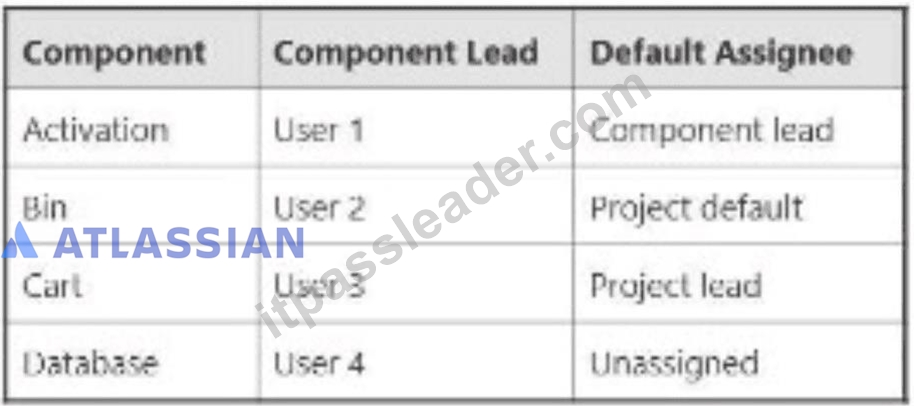
The Default Assignee for ENG is the Project Lead. You select all four components on a new issue and leave Assignee as Automatic. To whom will the issue be assigned?
- A. User 4
- B. User 3
- C. Project Lead
- D. User 2
- E. Unassigned
- F. User 1
Answer: C
Explanation:
In Jira Software Cloud, theAssigneefield for a new issue can be set toAutomatic, in which case Jira determines the assignee based on the project'sDefault Assigneesetting and any component-specificDefault Assigneesettings. The issue in the ENG project has all four components selected (Activation, Bin, Cart, Database), and the Assignee is left asAutomatic. The issue will be assigned to theProject Lead(Option E) due to the rules for handling multiple components with conflicting default assignees.
* Explanation of the Correct Answer (Option E):
* Project Default Assignee: The project ENG has itsDefault Assigneeset to theProject Lead, meaning that if no component-specific assignee is determined, the issue will be assigned to the Project Lead.
* Component Default Assignees:
* Activation: Default Assignee isComponent lead(User 1).
* Bin: Default Assignee isProject default(Project Lead).
* Cart: Default Assignee isComponent lead(User 3).
* Database: Default Assignee isUnassigned.
* Automatic Assignment Logic with Multiple Components: When an issue has multiple components selected, Jira evaluates theDefault Assigneefor each component:
* If all components have the same default assignee, that user is assigned.
* If components have different default assignees (or some are unassigned), Jira falls back to the project'sDefault Assignee(Project Lead in this case).
* In this scenario:
* Activationassigns to User 1.
* Binassigns to the Project Lead (via project default).
* Cartassigns to User 3.
* Databaseassigns to Unassigned.
* Since the components have conflicting default assignees (User 1, Project Lead, User 3, Unassigned), Jira cannot resolve to a single assignee and uses the project'sDefault Assignee, which is theProject Lead.
* Exact Extract from Documentation:
Configure default assignees
TheDefault Assigneefor a project or component determines who is assigned to new issues when theAssignee field is set toAutomatic.
Multiple components:
* If an issue has multiple components with different default assignees, Jira assigns the issue to the project'sDefault Assignee.To configure:
* Go toProject settings > Componentsto set component default assignees.
* Go toProject settings > Detailsto set the project'sDefault Assignee.Note: The project's Default Assigneeis used when component assignees conflict.(Source: Atlassian Support Documentation, "Manage project settings in Jira Cloud")
* Why This Fits: With conflicting default assignees across the four components, Jira assigns the issue to the project'sDefault Assignee, which is theProject Lead, making Option E the correct answer.
* Why Other Options Are Incorrect:
* User 1 (Option A):
* User 1 is the default assignee for theActivationcomponent (as the Component lead).
However, with multiple components selected and different assignees (User 1, Project Lead, User 3, Unassigned), Jira falls back to the project'sDefault Assignee(Project Lead), not User 1.
* Extract from Documentation:
If multiple components have different default assignees, the project'sDefault Assigneeis used, not a component-specific assignee.
(Source: Atlassian Support Documentation, "Manage project settings in Jira Cloud")
* User 2 (Option B):
* User 2 is the Component lead forBin, but the default assignee forBinis set toProject default(Project Lead), not the Component lead. Even if it were User 2, the conflicting assignees across components would result in the Project Lead being assigned.
* Extract from Documentation:
TheProject defaultsetting for a component assigns issues to the project'sDefault Assignee, not the Component lead.
(Source: Atlassian Support Documentation, "Manage components in Jira Cloud")
* User 3 (Option C):
* User 3 is the default assignee for theCartcomponent (as the Component lead). However, the conflicting assignees across components (User 1, Project Lead, User 3, Unassigned) result in the Project Lead being assigned, not User 3.
* Extract from Documentation:
Conflicting component assignees result in the project'sDefault Assigneebeing used.
(Source: Atlassian Support Documentation, "Manage project settings in Jira Cloud")
* User 4 (Option D):
* User 4 is the Component lead forDatabase, but the default assignee forDatabaseis Unassigned, not User 4. Even if it were User 4, the conflicting assignees would result in the Project Lead being assigned.
* Extract from Documentation:
TheUnassigneddefault assignee for a component does not override the project'sDefault Assigneein conflicts.
(Source: Atlassian Support Documentation, "Manage components in Jira Cloud")
* Unassigned (Option F):
* While theDatabasecomponent has a default assignee ofUnassigned, the presence of other components with different assignees (User 1, Project Lead, User 3) creates a conflict, and Jira assigns the issue to the Project Lead, notUnassigned.
* Extract from Documentation:
Unassignedas a default assignee is overridden by the project'sDefault Assigneein cases of conflict.
(Source: Atlassian Support Documentation, "Manage project settings in Jira Cloud")
* Additional Notes:
* TheDefault Assigneefor the project is set inProject settings > Details, and component-specific default assignees are set inProject settings > Components.
* The user creating the issue must have theAssign Issuespermission, and the Project Lead must have theAssignable Userpermission to be assigned.
* If only one component were selected (e.g., Activation), the issue would be assigned to User 1, but selecting all four components triggers the conflict resolution to the Project Lead.
:
Atlassian Support Documentation:Manage project settings in Jira Cloud
Atlassian Support Documentation:Manage components in Jira Cloud
Atlassian Support Documentation:Manage permissions in Jira Cloud
NEW QUESTION # 42
You run the JQL query shown:
assignee changed from currentUser() TO EMPTY and resolution changed to EMPTY Which statement is definitely true?
- A. All returned issues were assigned to you at some point.
- B. All returned issues are currently unresolved.
- C. All returned issues are currently not assigned to you.
- D. All returned issues are currently unassigned.
- E. All returned issues were in Done status at some point.
Answer: A
Explanation:
The JQL query assignee changed from currentUser() TO EMPTY and resolution changed to EMPTY filters for issues based on their change history for theassigneeandresolutionfields. The statement that is definitely true isall returned issues were assigned to you at some point(Option C), as the query explicitly requires that theassigneefield changed from the current user toEMPTY.
* Explanation of the Correct Answer (Option C):
* The query consists of two conditions:
* assignee changed from currentUser() TO EMPTY: This means the issue'sassigneefield was changed from the current user (the person running the query) tounassigned(EMPTY) at some point in its history. For this condition to be true, the issue must have been assigned to the current user before being unassigned.
* resolution changed to EMPTY: This means theresolutionfield was changed toEMPTY (unresolved) at some point, typically indicating the issue was reopened (e.g., resolution was cleared).
* Theassignee changed from currentUser() TO EMPTYcondition guarantees that all returned issues were assigned to the current user at some point, as the change history explicitly includes a transition from the current user to unassigned.
* Exact Extract from Documentation:
Advanced searching - operators reference
TheCHANGEDoperator searches for issues where a field's value changed from one value to another.
* assignee changed from currentUser() TO EMPTY: Finds issues where the assignee was changed from the current user to unassigned.
* resolution changed to EMPTY: Finds issues where the resolution was cleared (e.g., issue was reopened).Note: TheCHANGEDoperator examines the issue's history, not its current state.(Source: Atlassian Support Documentation, "Advanced searching - operators reference")
* Why This Fits: The query's conditionassignee changed from currentUser() TO EMPTY ensures that all returned issues were assigned to the current user at somepoint, making Option C definitely true.
* Why Other Options Are Incorrect:
* All returned issues are currently unresolved (Option A):
* Theresolution changed to EMPTYcondition means the resolution was set toEMPTYat some point in the issue's history, but the issue could have been resolved again later (e.g., resolution set to Done). The query does not check the current resolution state, so this is not definitely true.
* Extract from Documentation:
TheCHANGEDoperator does not guarantee the current state of a field. Use resolution is EMPTY to check if issues are currently unresolved.
(Source: Atlassian Support Documentation, "Advanced searching - operators reference")
* All returned issues are currently unassigned (Option B):
* Theassignee changed from currentUser() TO EMPTYcondition means the issue was unassigned at some point, but it could have been reassigned to another user later. The query does not check the current assignee state, so this is not definitely true.
* Extract from Documentation:
To check if issues are currently unassigned, use assignee is EMPTY. TheCHANGEDoperator only checks historical changes.
(Source: Atlassian Support Documentation, "Advanced searching - fields reference")
* All returned issues are currently not assigned to you (Option D):
* The query does not guarantee that issues are currently not assigned to the current user.
After being unassigned (TO EMPTY), the issue could have been reassigned to the current user again. The current assignee state is not checked, so this is not definitely true.
* Extract from Documentation:
TheCHANGEDoperator does not reflect the current field value. Use assignee != currentUser() to check if issues are not assigned to the current user.
(Source: Atlassian Support Documentation, "Advanced searching - operators reference")
* All returned issues were in Done status at some point (Option E):
* Theresolution changed to EMPTYcondition indicates the resolution was cleared (e.g., issue reopened), which often follows a resolved state (e.g., Done). However, the query does not explicitly require that the issue was in aDonestatus (or had a resolution set) before the change toEMPTY. For example, an issue could have had a resolution set to another value or cleared without being inDone. Thus, this is not definitely true.
* Extract from Documentation:
Theresolution changed to EMPTYcondition indicates a resolution was cleared, but it does not guarantee the issue was in a specific status like Done.
(Source: Atlassian Support Documentation, "Advanced searching - fields reference")
* Additional Notes:
* The query examines historical changes, not current states, so assumptions about currentresolution orassigneevalues are invalid.
* To ensure current states, additional conditions like resolution is EMPTY or assignee is EMPTY would be needed.
* The query requires the user to haveBrowse Projectspermission for the relevant projects.
:
Atlassian Support Documentation:Advanced searching - operators reference Atlassian Support Documentation:Advanced searching - fields reference Atlassian Support Documentation:Search for issues using JQL
NEW QUESTION # 43
Your Jira instance has a Select List custom field named Application, which lists all the Atlassian offerings. You need to write a JQL query that shows all issues due within the next month for Jira, Trelb, and Jira Align applications.
Which query will satisfy the requirement?
- A. (Application =^Jire^ OR Application = ^Trelb. OR Application = ^Jim Align-) AND duedate startOrMonth(1m) AND duedate <= endOrMonth(,m)
- B. Application IN (Jira,Trelb, ^Jim Align.) AND * &iodate >. startOrMonth(1) AND &iodate <= endOrMonth(1)
- C. Application = ^Jim^ OR Application = OR * Application = ^Jim Align^ AND duedate startOrMonth(1) OR duedate <= endOrMonth(1)
- D. Application IN (Jira, Trelb, ^Jim Align-) AND * (duedate>= startOrMonth(1) OR duedate <= endOrMonth(1))
- E. Application IN (Jira,Trelb,Jira Align) AND * (duedate>= startOrMonth(1M) AND duedate<= endOrMonth(1M))
Answer: E
NEW QUESTION # 44
Your business users want to know more about what is happening with the issues raised by their business unit. They gave you a list of situations in which they want to get emails, so you know which parts of the shared notification scheme they want to be added to.
You consult with the project owner.
He doesn't want any changes to the emails that go to developers and testers.
The project owner approves of the business users getting the emails, but he would like to retain control of who gets emails for his project.
How can you satisfy these requests?
- A. Modify the events in the workflow so they send the emails to the business users.
- B. Create a role for business users and add that role to the events in the notification scheme.
- C. Add the business users as Watchers on the issues.
- D. Place the business users in a group and add that group to the events in the notification scheme.
Answer: D
NEW QUESTION # 45
......
ATLASSIAN ACP-120 (Jira Cloud Administrator) Certification Exam is a vendor-neutral certification offered by ATLASSIAN, a leading software development company. Jira Cloud Administrator certification exam consists of 75 multiple-choice questions that need to be answered within 180 minutes. The questions are designed to test the candidate's understanding of Jira Cloud features and functionalities, as well as their ability to apply Jira Cloud to real-world scenarios. Upon successful completion of the exam, candidates will receive a digital badge and a certificate that recognizes their expertise in Jira Cloud administration. Jira Cloud Administrator certification is valid for two years and can be renewed by passing the recertification exam.
ACP-120 Study Guide Realistic Verified ACP-120 Dumps: https://troytec.itpassleader.com/ATLASSIAN/ACP-120-dumps-pass-exam.html