

Free Sales Ending Soon - 100% Valid AACE-PSP Exam Dumps with 218 Questions
Verified AACE-PSP dumps Q&As on your AACE Certification Exam Questions Certain Success!
AACE International AACE-PSP certification is an essential certification for professionals in the field of project planning and scheduling. Planning & Scheduling Professional (PSP) Exam certification covers a wide range of topics related to project management, and the exam is designed to test the competency of individuals in these areas. If you are a project manager, project planner or project scheduler, earning the AACE-PSP designation can help you advance your career and demonstrate your expertise in the field.
NEW QUESTION # 119
The characteristic of the precedence diagramming method that models construction projects differently than the arrow diagramming method is that it____________.
- A. uses arrows to signify logic in a network
- B. can be used to calculate the late start and late finish of all activities
- C. allows more than one critical path to be represented
- D. allows multiple relationship types to be associated with activities
Answer: A
NEW QUESTION # 120
Which of the following options is NOT a feasible method to reduce the overall completion time of the toll road program?
- A. Allocating forces from other BILCO contracts to the toll road project
- B. Proceeding with the work in advance of the environmental studies
- C. Subcontract outside forces to accelerate the Phase A Schedule
- D. Reduce the phasing from 5 phases to 3 phases
Answer: B
Explanation:
* Proceeding without completing environmental studies introduces compliance risks, such as legal challenges or project shutdowns. This is not a feasible method for reducing the overall completion time as it contradicts environmental regulations and ethical standards.
* Methods like subcontracting (A) or reallocating resources (B) are feasible, as they leverage resource management.
* Reference: PSP Study Guide, Section 1.2.3 - Stakeholder Considerations, and Section 1.3.13 - Risk and Recovery Planning, which emphasize compliance with regulations and avoiding unmanageable risks.
NEW QUESTION # 121
For activity 11001. why would the crashed direct cost be greater than the direct cost of the normal schedule?
- A. Management bonuses for early completion were included in this activity
- B. Additional extended overhead is also being shown in this activity
- C. Generally, more equipment is used for a crashed project; therefore, it costs more to demobilize
- D. Some costs resulting from the crashed efforts were forgotten in previous activities
Answer: B
Explanation:
Crashing increases direct costs as additional resources, equipment, or expedited delivery methods are employed to shorten the project duration. The PSP Study Guide (Section 2.3.5, "Acceleration") highlights that crashing involves trade-offs between time and cost, often resulting in higher demobilization costs due to the increased deployment of equipment and resources.
NEW QUESTION # 122
How many entities/subcontractors should a scheduled activity cover?
- A. Only one
- B. More than one it the activity is in a single calendar period
- C. More than one it the subcontractors agree
- D. More than one if the concurrent work cannot be split between subcontractors
Answer: A
NEW QUESTION # 123
Select the most appropriate explanation for use of a winter/wet weather seasonal calendar for use in this project?
- A. to show a difference in the calendar year
- B. to highlight a time when there are more holidays and work therefore will be slower and there will be more absenteeism
- C. to provide a key to co-a weather for safety meetings
- D. to denote a time during which work may not progress as fast as planned and cost and risk may be elevated
Answer: D
Explanation:
The use of a winter/wet weather seasonal calendar is essential in planning and scheduling to account for climatic conditions that can impact project timelines. The PSP Study Guide emphasizes identifying project variables, such as environmental conditions, and incorporating them into the project plan to manage risks and constraints effectively. Seasonal calendars help planners predict periods of reduced productivity, increased costs, and potential delays due to adverse weather conditions (PSP Study Guide, Subchapter 1.2.4, "Project Variables").
These calendars are particularly useful for:
Forecasting potential schedule impacts during specific periods.
Enhancing the accuracy of risk management plans (PSP Study Guide, Section 1.3.13, "Risk and Recovery Plan").
Aiding in decision-making regarding resource allocation during slow periods.
NEW QUESTION # 124
Free float is the
- A. Difference between the early dates and late dates of an activity.
- B. Amount of time the early start of an activity can be delayed without impacting the early start of the successor activity.
- C. Difference between the early finish dates and late finish dates of an activity.
- D. Difference In float value of the critical path activities and the float value of the specific activity being analyzed.
Answer: B
NEW QUESTION # 125
When resource leveling craft labor for a critical path schedule, the scheduler
- A. Can depend on the results of the resource leveling operation to reflect a useful realignment of all schedule activities without 'further analysis.
- B. Need only consider the non-union crafts persons.
- C. Need not consider its effects, as it is a theoretical concept with limited application to construction projects.
- D. Must consider breaks in continuity of work for subcontractors, thereby possibly incurring additional subcontractor mobilization and demobilization costs.
Answer: A
NEW QUESTION # 126
Which of the following project planning situations is the most frequent contributor to cost overruns?
- A. Inadequate definition of scope at the estimate (budget) stage
- B. lack of detailed planning for operational start-up
- C. Inappropriate definition of work breakdown structure
- D. Insufficient planning for change management
Answer: A
NEW QUESTION # 127
Which of the following phases does NOT describe the commonly accepted construction life cycle?
- A. Turnover and start-up phase.
- B. Claims and disputes phase.
- C. Installation phase.
- D. Planning and design phase.
Answer: B
Explanation:
* Construction Life Cycle Phases:
Common phases: planning and design, installation (execution), and turnover/start-up.
Claims and disputes may arise during the project but are not a defined phase of the construction life cycle.
* PSP Study Guide Reference:
The study guide outlines standard phases without including claims and disputes as a formal phase.
* Conclusion: The correct answer is A, as claims and disputes are not an inherent phase of the construction life cycle.
NEW QUESTION # 128
Scenario: You are providing construction management services for a small office building project. Your duties include reviewing and approving the contractor's baseline schedule. The contractor has submitted the first baseline schedule for the project.
The contractor's baseline schedule submittal includes a bar chart, but no CPM diagram. Which of the following is the most significant shortcoming to using a bar chart to review the baseline?
- A. A bar chart cannot accurately reflect the impact of changes in durations or logic to the baseline
- B. A bar chart is always an oversimplified view of the project schedule
- C. A tor chart does not show all the activities required to construct the project
- D. A bar chart does not show whether the project with be completed within the allowable time
Answer: A
NEW QUESTION # 129
Assuming that you had only one crane capable of 30 lifts per day, 3 column pours requiring 28 lifts each, plus associated assorted work requiring an additional 150 lifts, what is the minimum planned working duration for this work?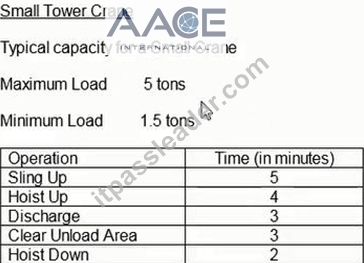
- A. 8 work days
- B. 18 work days
- C. 15 workdays
- D. 7 work days
Answer: B
Explanation:
* Calculation of Total Lifts Required:
3 column pours = 28×3=8428 \times 3 = 8428×3=84.
Additional lifts = 150150150.
Total lifts = 84+150=23484 + 150 = 23484+150=234.
* Lifts Per Day with One Crane:
1 crane performs 30 lifts per day.
* Required Duration:
Minimum planned working duration = ⌈234÷30⌉=18\lceil 234 \div 30 \rceil = 18⌈234÷30⌉=18.
* Verification with PSP Guidelines:
Aligning workload with equipment capacity ensures practical schedule planning (Ref: PSP Study Guide, Chapter 2B: Workload Balancing).
NEW QUESTION # 130
Crane operators require 1 hour prep and 1 hour clean-up and inspection per day. There is only 1 crane operator allocated per crane. Crane operators are not allowed to work more than 8 hours a day. Lunchtime break lasts 1 hour. Assuming a 10 minute cycle time, how many lifts per day can be expected?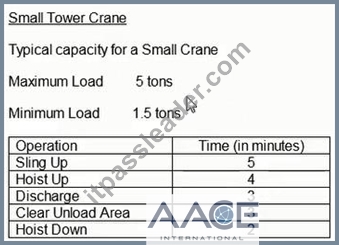
- A. 30 lifts
- B. 24 lifts
- C. 36 lifts
- D. 48 lifts
Answer: C
NEW QUESTION # 131
Using the "normal" schedule, given Activity 3001 and the relationship with Activity 4001, what is indicated?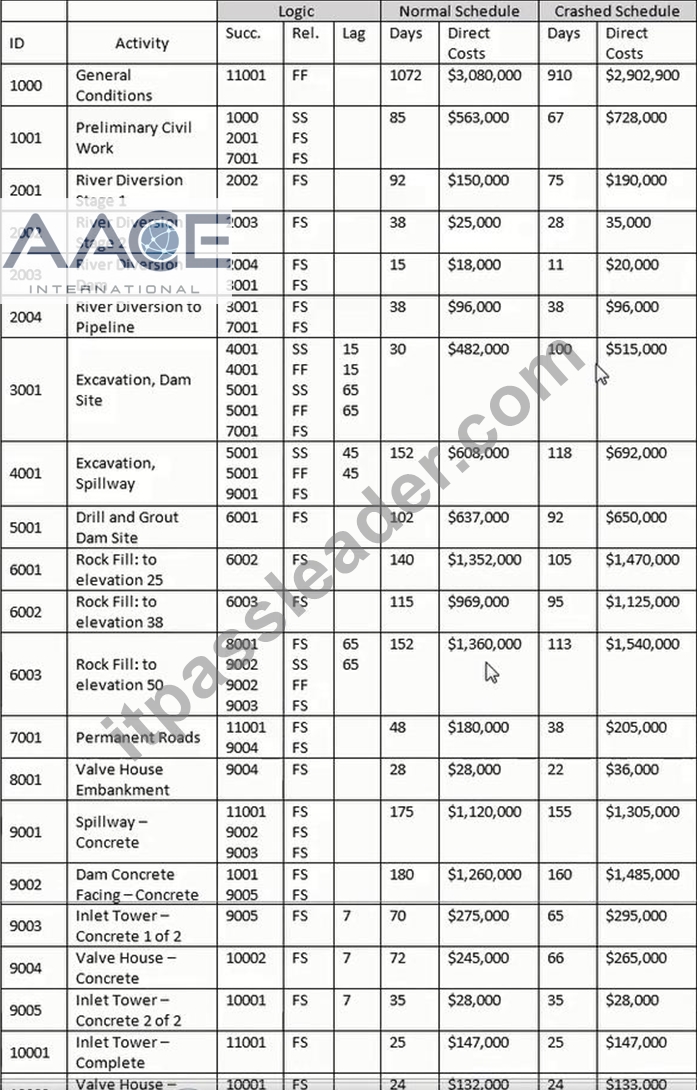
- A. The activities occur in series with a 15-day lag.
- B. These activities are concurrent with Activity 4001 starting 15 days earlier than the start of Activity 3001.
- C. The activities run concurrently.
- D. These activities are concurrent with Activity 4001 starting 15 days after the start of Activity 3001.
Answer: A
NEW QUESTION # 132
A driving relationship is _____________________.
- A. The link between a predecessor and the activity whose dates it controls.
- B. The link between two related activities.
- C. A critical relationship.
- D. A finish-to-start relationship.
Answer: A
NEW QUESTION # 133
Using the normal schedule and excluding general conditions, which activities are NOT on the critical path?
- A. 2003,8001.9001.9002,9005,10001
- B. 7001, 8001, 9001. 9003. 9004. 10002
- C. 6001, 8001, 9001. 9002, 9004. 9005
- D. 5001,7001.8001,9001,9004,9005
Answer: D
Explanation:
Activities not on the critical path are those with positive float, meaning they can be delayed without affecting the overall project completion time. The determination of such activities requires performing a forward and backward pass calculation as per CPM (Critical Path Method) analysis principles (PSP Study Guide, Section 2.2.4, "Relationships").
For example:
Identify the critical path by analyzing total float values (typically, critical path activities have zero total float).
Exclude activities that do not fall on the critical path.
NEW QUESTION # 134
Determine the correct formula and date for the late start for Activity 9001.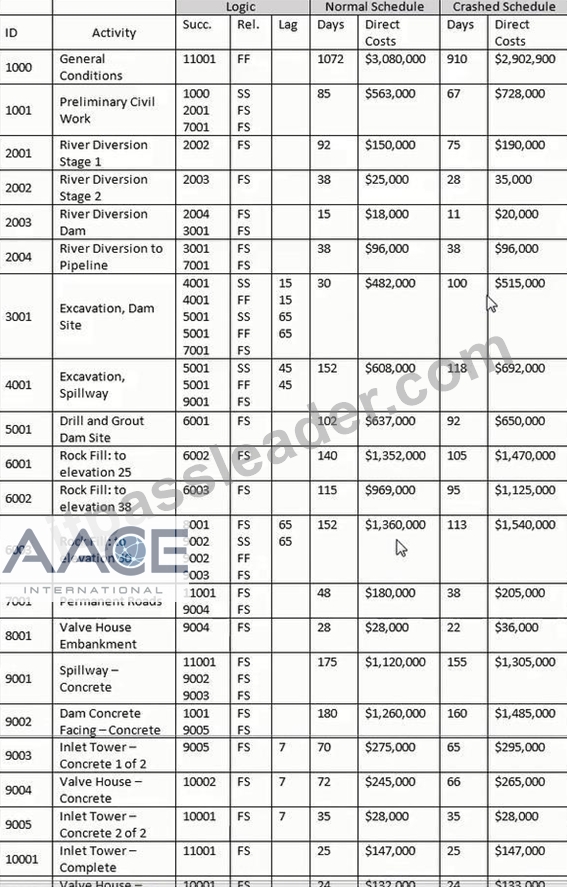
- A. LF.9001 Dur.9001 -> 11-20-02.
- B. The early finish is required in order to determine the answer.
- C. LS.6001 Dur.6001 -> 11-20-02.
- D. There is insufficient data provided to calculate the answer.
Answer: A
NEW QUESTION # 135
If a detailed estimate is NOT available to assist in the formulation of activity durations but unit quantities have been identified, what information can be utilized to estimate work package/activity durations?
- A. Historical production rates
- B. Black-Scholes model
- C. The Eichleay formula
- D. Time impact analysis
Answer: A
Explanation:
When detailed estimates are unavailable, historical production rates can provide reliable data for estimating durations based on past projects with similar work.
Option A (Eichleay formula) is for overhead cost allocation.
Option C (Time impact analysis) evaluates delay impacts, not durations.
Option D (Black-Scholes model) is irrelevant in this context.
Historical data usage is a recognized method in project planning and scheduling practices.
NEW QUESTION # 136
......
AACE-PSP Exam Dumps - 100% Marks In AACE-PSP Exam: https://troytec.itpassleader.com/AACE-International/AACE-PSP-dumps-pass-exam.html