

Guaranteed High Marks with Updated & Real UiPath-ADAv1 Dumps pdf Free Updates
PASS RATE UiPath Certified Professional - Developer Track UiPath-ADAv1 Certified Exam DUMP
UiPath UiPath-ADAv1 Exam Syllabus Topics:
| Topic | Details |
|---|---|
| Topic 1 |
|
| Topic 2 |
|
| Topic 3 |
|
| Topic 4 |
|
| Topic 5 |
|
| Topic 6 |
|
| Topic 7 |
|
| Topic 8 |
|
| Topic 9 |
|
| Topic 10 |
|
| Topic 11 |
|
| Topic 12 |
|
NEW QUESTION # 207
When should the Show Elements button be used in the Computer Vision wizard?
- A. Filtering out specific UI elements from being processed by the Computer Vision engine.
- B. Highlighting all Ul elements that have been identified by the Computer Vision analysis.
- C. Activating a real-time view of the target app's UI during automation.
- D. Displaying a list of all available UI elements and their properties.
Answer: B
Explanation:
Explanation
The Show Elements button in the Computer Vision wizard is used to toggle the highlighting of all UI elements that have been detected by the Computer Vision engine on the target application. This helps to visualize the accuracy and scope of the UI element recognition and to select the desired UI element for automation. (UiPath Automation Developer study guide) References:
Computer Vision
Computer Vision Wizard
NEW QUESTION # 208
A developer is automating an invoice process for the finance department using a Dispatcher and Performer model with access to Orchestrator.
Each morning, new invoices are added to a shared folder. Each invoice needs to be processed separately as a single unit of work. After processing, the system output ID must be emailed to the finance team.
How should the developer store the invoice data in Orchestrator?
- A. Upload individual invoice data and the finance team email address as Specific Data in Queue Items.
- B. Create an asset for each piece of invoice data as well as for the finance team email address.
- C. Upload the finance team email address as Specific Data in Queue Items and Create an asset for each individual invoice data field.
- D. Upload individual invoice data as Specific Data in Queue Items and Create an Asset for the finance team email address.
Answer: A
Explanation:
The best practice in Dispatcher-Performer architecture is:
* Dispatcher: Adds each invoice as a Queue Item in Orchestrator.
* Performer: Processes each invoice separately and updates the finance team with the output ID.
Why is B Correct?
# Invoice data and finance team email address should be included as Specific Data in Queue Items:
* This ensures each invoice contains all necessary details.
* Each transaction is processed individually with all relevant data.
Why Other Options Are Incorrect?
References:
# UiPath Best Practices - Queue Items vs. Assets# Dispatcher-Performer Model in UiPath
NEW QUESTION # 209
Which activity is best suited for a developer to find images on a website and store them in a local folder, while accounting for the need to potentially search for an image repeatedly due to errors on the website?
- A. Delay
- B. Get Attribute
- C. Check App State
- D. Retry Scope
Answer: D
Explanation:
The Retry Scope activity is used for handling intermittent failures and retrying an operation when needed.
Why is Option A Correct?
* Handles website errors gracefully (e.g., image load failures, slow internet).
* Automatically retries the image search a defined number of times.
* Example Usage:
- Use Find Image activity inside Retry Scope
- If the image is not found, it retries X times
- Once found, use Save Image activity to store locally
Why Other Options Are Incorrect?
* B (Get Attribute) #
* Retrieves element attributes but cannot handle retry logic.
* C (Check App State) #
* Used for UI state detection, not error recovery.
* D (Delay) #
* Introduces fixed waiting time, but does not retry operations dynamically.
NEW QUESTION # 210
A developer creates a process that uses data from multiple sources and uploads it to an Orchestrator queue.
The data originates from emails in different email inboxes and needs to be processed in the same order in which the email was received. To ensure the Queue Items are processed in the correct order, which property of the Add Queue Item activity should be used?
- A. Reference
- B. ItemInformation
- C. Postpone
- D. Deadline
Answer: C
Explanation:
The Postpone property of the Add Queue Item activity allows you to specify a date and time when the queue item becomes available for processing. This can be used to ensure that the queue items are processed in the same order as the emails were received, by setting the Postpone value to the email received date and time.
(UiPath Studio - Add Queue Item - UiPath Academy)
NEW QUESTION # 211
Data from an Excel file is read into a data table named "dtEmployee", as displayed in the following graphic: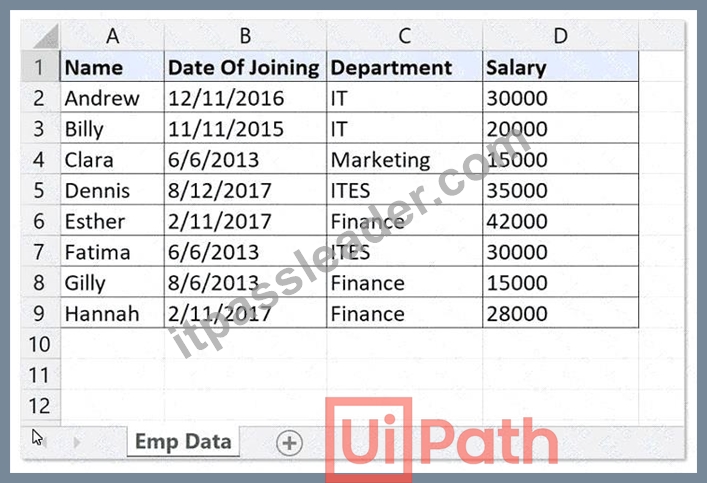
A developer needs to filter the data table to obtain all rows representing employees from the Finance and IT departments with a Salary under 30,000. Which expression yields the desired outcomes?
- A. dtEmployee.Select("([Department]='IT' AND [Department]='Finance') AND [Salary] < 30000")
- B. dtEmployee.Select("([Department]='IT' OR [Department]='Finance') AND [Salary] < 30000")
- C. dtEmployee.Select("[Department]='IT' OR [Department]='Finance' AND [Salary] < 30000")
- D. dtEmployee.Select("[Department]='IT' OR [Department]='Finance' OR [Salary] < 30000")
Answer: B
Explanation:
This expression filters the data table to obtain all rows representing employees from the Finance and IT departments with a Salary under 30,000. The expression uses the Select method of the data table, which returns an array of data rows that match a specified condition. The condition is written as a string that follows the syntax and rules of the DataColumn.Expression property. The condition uses parentheses to group the logical operators OR and AND, which have different precedence levels. The OR operator returns true if either operand is true, while the AND operator returns true only if both operands are true. The condition also uses single quotes to enclose the string values of the Department column, and the less than operator to compare the numeric values of the Salary column. (UiPath Studio documentation1)
NEW QUESTION # 212
A developer defines new log fields using the Add Log Fields activity. When will the custom log fields stop being added to the robot execution logs?
- A. When a Remove Log Fields activity is used to remove them.
- B. When the first Log Message activity is executed.
- C. When a Log Message activity is executed with Log Level = Warn or higher.
- D. When an Exception is caught and handled.
Answer: A
Explanation:
The Add Log Fields activity adds custom log fields to the Robot Execution Logs for every Log Message execution throughout the entire workflow1. The custom log fields will persist until a Remove Log Fields activity is used to remove them2. The other options are not correct.
NEW QUESTION # 213
A developer has created the following workflow: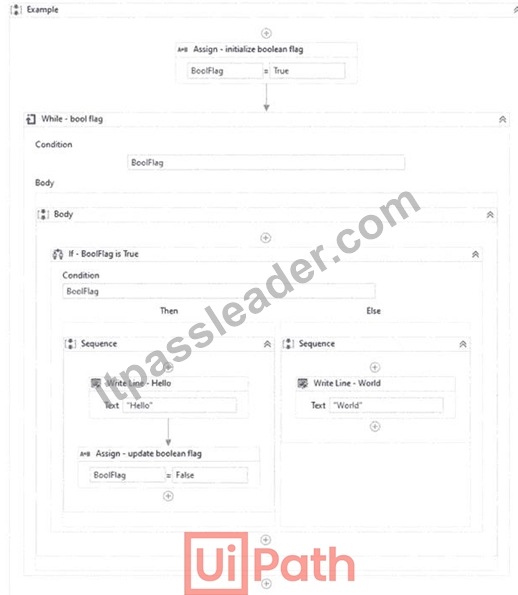
Based on the exhibit, which output is produced in the Output panel?
- A. Hello
- B. World Hello
- C. World
- D. Hello World
Answer: D
Explanation:
The output panel will display "Hello World" because the workflow is designed to first display "Hello" and then "World" in the output panel. The workflow starts with an Assign activity that initializes the Boolean flag to True. Then, the While activity checks if the flag is True. If it is, the workflow enters the Body section of the While activity. Inside the Body section, the workflow checks if the flag is True. If it is, the workflow enters the Then section of the If activity and displays "Hello" in the output panel. Then, the Assign activity sets the flag to False. Since the flag is now False, the workflow enters the Else section of the If activity and displays "World" in the output panel. Finally, the workflow exits the While activity since the flag is now False.
NEW QUESTION # 214
A developer wants to add items to a list of strings using the Invoke Method activity. The list is declared as follows: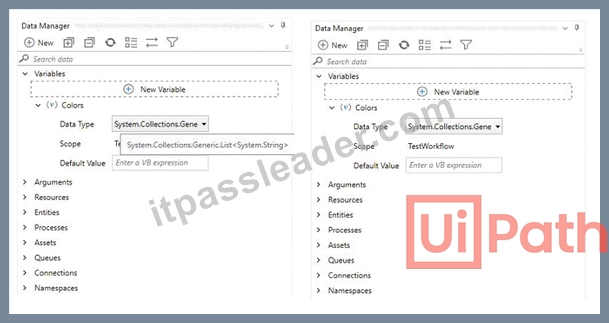
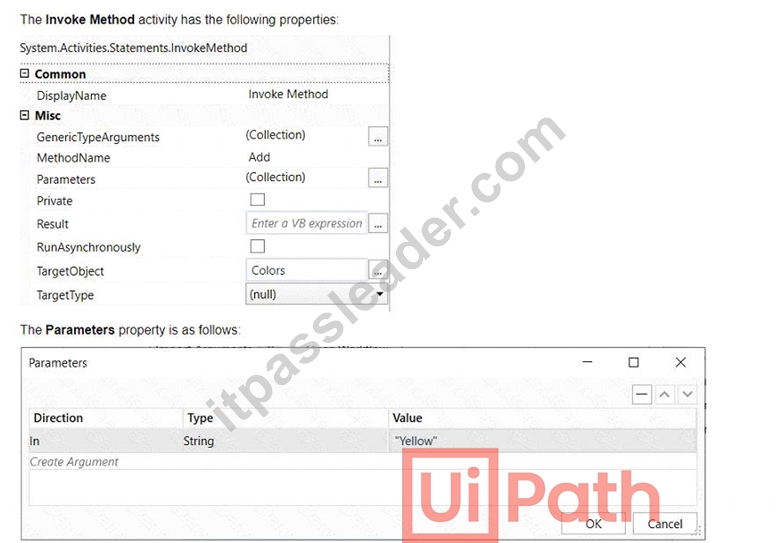
Based on the information shown in the exhibits, what is the outcome of the Invoke Method activity?
- A. Colors will contain an item with the value "Yellow".
- B. Colors will contain an item with an empty value.
- C. An exception will be thrown.
- D. Colors will contain an item with the value "Colors: Yellow".
Answer: A
Explanation:
The Invoke Method activity is used to add items to a list of strings. In this case, the list is declared as "Colors".
The outcome of the Invoke Method activity will be that the list "Colors" will contain an item with the value
"Yellow". This is because the TargetObject property is set to "Colors", which is the list variable, the MethodName property is set to "Add", which is the method of the list class, and the Parameters property is set to "Yellow", which is the value to be added to the list. (UiPath Studio documentation1) References:
1: Invoke Method - UiPath Activities.
NEW QUESTION # 215
Suppose a developer is working with a 2023 yearly calendar. To expand the calendar into a monthly view, the developer must always click on the 15th day of the current month and add an event.
The selector for the Event Date Element activity in March is presented as follows:
<wnd app='applicationframehost.exe' title='Month View - Calendar' />
<uia cls='Day' name='15 March 2023' />
How should the selector be altered to guarantee that it clicks on the 15th of the ongoing month?
- A. <wnd app='applicationframehost.exe' title='Month View - Calendar' />
<uia cls='Day' name='*15*' /> - B. <wnd app='applicationframehost.exe' title='Month View - Calendar' />
<uia cls='Day' name='15 * 2023' /> - C. <wnd app='applicationframehost.exe' title='Month View - Calendar' />
<uia cls='Day' name='15 ? 20 ?? ' /> - D. <wnd app='applicationframehost.exe' title='Month View - Calendar' />
<uia cls='Day' name='15* 20 ?? ' />
Answer: D
Explanation:
Explanation
This is the correct option because it uses wildcards to replace the dynamic parts of the selector. Wildcards are symbols that enable you to replace zero or multiple characters in a string. They are useful when dealing with attributes that change dynamically in the selector. There are two types of wildcards: asterisk () and question mark (?). The asterisk () replaces zero or more characters, while the question mark (?) replaces a single character. In this case, the name attribute of the target element changes according to the month, but the day and the year remain constant. Therefore, the selector can be altered by replacing the month name with an asterisk () and the last two digits of the year with two question marks (??). This way, the selector will match any element that has the name starting with 15, followed by any characters, followed by 20, followed by any two characters. For example, the selector will match 15 March 2023, 15 April 2023, 15 May 2023, etc. The other options are incorrect because they either do not use wildcards, or they use them incorrectly. Option A does not replace the last two digits of the year, which may change in the future. Option C replaces too many characters with the asterisk (), which may cause ambiguity or false matches. Option D uses the question mark (?) incorrectly, as it should be used for single characters, not for spaces or multiple characters. References: Selectors With Wildcards
NEW QUESTION # 216
What activity from the Microsoft 365 package should be used to share a SharePoint file URL with specific permissions to a specific user?
- A. Get File/Folder
- B. Share File/Folder
- C. Upload File
- D. Move File/Folder
Answer: B
Explanation:
The "Share File/Folder" activity in the Microsoft 365 package is used to share a SharePoint file or folder URL with a specific user while defining access permissions.
* This activity allows setting view/edit permissions and sending notifications to the recipient.
* Example usage:
- Input: File URL, Email ID, Permission Type (View/Edit)
- Output: Shared link
* Other options are incorrect:
* A (Upload File) is used to store new files in SharePoint.
* B (Move File/Folder) moves files or folders within SharePoint.
* C (Get File/Folder) retrieves file details but does not handle sharing.
# Reference: UiPath Microsoft 365 Activities - Share File/Folder
NEW QUESTION # 217
Which of the following properties is optional when creating a new argument?
- A. Argument type
- B. Direction
- C. IsRequired
- D. Default value
Answer: D
Explanation:
Arguments have mandatory and optional properties.
* Mandatory Properties:
* Argument Type # Defines the data type (String, Int32, etc.).
* Direction # Determines how the argument is used (In, Out, In/Out).
* Optional Properties:
* Default Value # Can be left empty, meaning it is not required.
* IsRequired # Not all arguments must be required.
Why is A Correct?
# Default Value is optional because:
* Not all arguments need a predefined value.
* Some arguments get values dynamically at runtime.
References:
# UiPath Official Documentation - Argument Properties
NEW QUESTION # 218
What are Application Files in a ServiceNow application?
- A. An XML export of an application's table records
- B. ServiceNow artifacts comprising an application
- C. CSV files containing data imported into an application
- D. XML exports of an application's Update Set
Answer: B
Explanation:
Comprehensive and Detailed Explanation:
In ServiceNow, Application Files refer to the various components or artifacts that make up an application.
These include modules, scripts, tables, client scripts, business rules, UI policies, and other elements that define the application's functionality and behavior. When an application is developed, all these artifacts are collectively referred to as Application Files.
* Option A (Incorrect): CSV files are typically used for data import purposes and are not considered part of the application's core artifacts.
* Option B (Incorrect): XML exports of an Update Set represent a collection of changes or customizations made to the system, which can be moved between instances. While related, they are not synonymous with Application Files.
* Option C (Incorrect): An XML export of a table's records pertains to the data within a table, not the structural or functional components of the application itself.
* Option D (Correct): Application Files encompass all the ServiceNow artifacts that comprise an application, defining its structure and behavior.
Understanding Application Files is crucial for developers, as they represent the building blocks of any ServiceNow application, ensuring all necessary components are packaged and deployed correctly.
NEW QUESTION # 219
When using the UiPath Strict selector as a targeting method, how does it interact with anchor usage?
- A. The Strict selector always works better with multiple anchors.
- B. Anchors are not used when only the Strict selector is enabled as a targeting method.
- C. The Strict selector only uses anchors that are automatically identified.
- D. The Strict selector requires at least two anchors to function correctly.
Answer: B
Explanation:
The Strict selector relies only on the UI element's full selector and does not use anchors.
Why is Option B Correct?
* Strict selectors contain only reliable UI element attributes (title, id, class, etc.).
* No anchors are needed, as the element is uniquely identified through direct targeting.
* Anchors are used only in Fuzzy or Image-based selectors for dynamic UI elements.
Why Other Options Are Incorrect?
* A (Strict selector always works better with multiple anchors.) #
* Incorrect. The Strict selector does not use anchors at all.
* C (Strict selector requires at least two anchors.) #
* Incorrect. Anchors are irrelevant in Strict mode.
* D (Strict selector only uses automatically identified anchors.) #
* Incorrect. Strict selectors do not use anchors, manually or automatically.
NEW QUESTION # 220
A developer aims to employ the REFramework for automating a business process that involves a TransactionData collection (DataTable) comprising vendor names and addresses.
Instructions: Choose the appropriate variable type for the Transactionltem from the provided drop-down list in the following exhibit.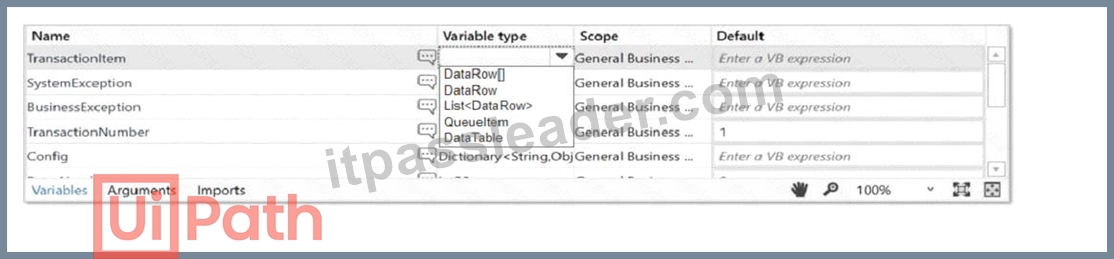
Answer:
Explanation: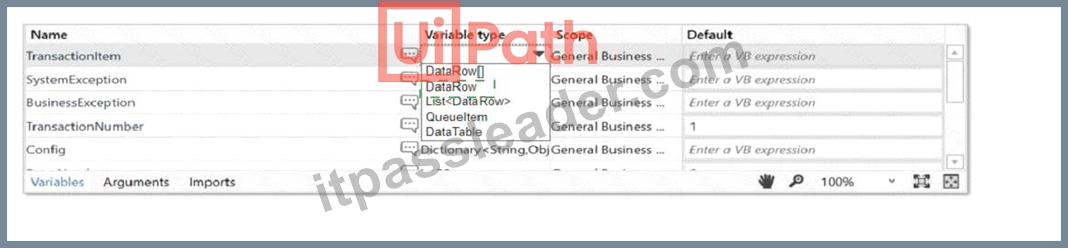
Explanation
DataRow
The REFramework is a template that provides a robust and scalable structure for building automation projects. It uses the concept of TransactionData and TransactionItem to handle the input data and process it in a loop1. The TransactionData is a collection of items that need to be processed, and the TransactionItem is a single item from that collection that is assigned to the robot in each iteration2.
The type of the TransactionItem variable depends on the type of the TransactionData variable. By default, the REFramework uses QueueItem as the type for both variables, assuming that the input data comes from an Orchestrator queue3. However, if the input data comes from a different source, such as an Excel file, a web page, or a SAP application, then the type of both variables needs to be changed accordingly4.
In your case, since the input data is a DataTable that contains vendor names and addresses, the appropriate type for the TransactionItem variable is DataRow. A DataRow represents a single row in a DataTable, and it can store multiple values in its columns. By using DataRow as the type for the TransactionItem variable, you can access and manipulate the vendor information in each iteration of the process.
References:
REFramework Documentation - UiPath Documentation Portal.
ReFramework - TransactionItem type - Help - UiPath Community Forum.
ReFramework for Tabular Data - RPA Component - UiPath Marketplace.
Transaction Item variable type - Studio - UiPath Community Forum.
[DataRow Class (System.Data) | Microsoft Docs].
NEW QUESTION # 221
How do you correctly create an array of strings containing the folder names from the variable FullFilePath = "C:\Users\UiPathRobot\Documents\Technologies"?
- A. Split("", FullFilePath)
- B. String.Replace(FullFilePath, '"')
- C. String.Replace('"', FullFilePath)
- D. Split(FullFilePath, "\")
Answer: D
Explanation:
To extract folder names from a full file path, we need to split the path based on the backslash (\) separator.
The correct approach is:
folderNames = FullFilePath.Split("\"c)
* This will split "C:\Users\UiPathRobot\Documents\Technologies" into an array:
{"C:", "Users", "UiPathRobot", "Documents", "Technologies"}
* Split("", FullFilePath) (Option D) is incorrect because it does not specify a delimiter.
* String.Replace does not perform splitting and is not relevant here.
# Reference: UiPath Official Documentation - String Manipulation
NEW QUESTION # 222
A developer is building a process which reads invoice data from the "mvoices.csv " file that includes a Total column of type Double.
Instructions: Using the drop-down lists shown in the following exhibit, configure the Filter Data Table Wizard to keep all invoices with a Total value that is over 10 000 USD.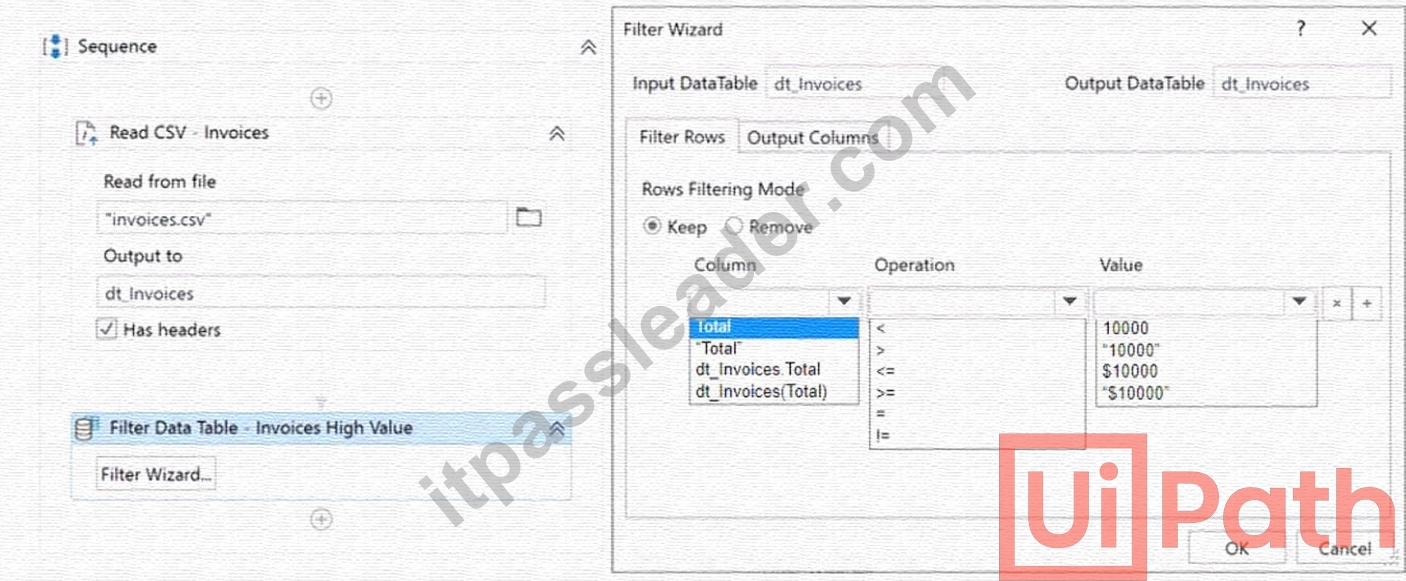
Answer:
Explanation: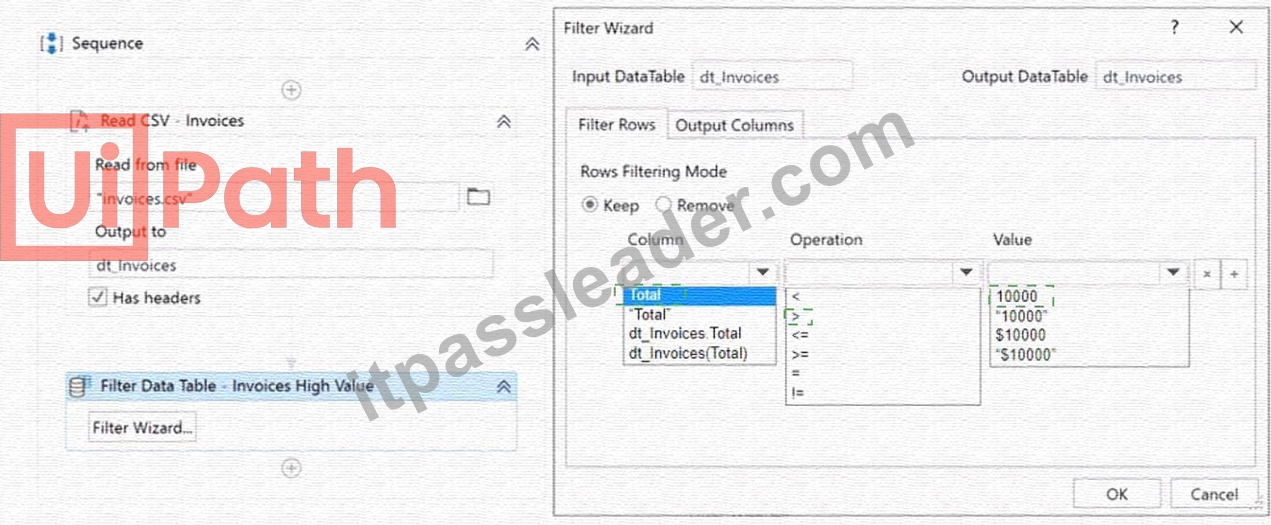
Explanation
To configure the Filter Data Table Wizard to keep all invoices with a Total value that is over 10 000 USD, you should choose the following options from the drop-down lists:
Column: Total Operation: > Value: 10000
The reason for choosing these options is to filter the data table based on the condition that the Total column value is greater than 10000. This will keep only the rows that satisfy this condition and remove the rest. You can learn more about the Filter Data Table activity and how to use it from the following sources:
Four Ways to Filter Data Tables in UiPath Studio | UiPath
How to Filter Data Table - Help - UiPath Community Forum
Filter Data table with specific column - UiPath Community Forum
NEW QUESTION # 223
......
Best UiPath-ADAv1 Exam Preparation Material with New Dumps Questions: https://troytec.itpassleader.com/UiPath/UiPath-ADAv1-dumps-pass-exam.html