

Latest C_BCBAI_2502 exam dumps with real SAP questions and answers
C_BCBAI_2502 Exam in First Attempt Guaranteed
SAP C_BCBAI_2502 Exam Syllabus Topics:
| Topic | Details |
|---|---|
| Topic 1 |
|
| Topic 2 |
|
| Topic 3 |
|
NEW QUESTION # 10
A retail business wants to use AI for automating customer support while ensuring personalized customer interactions. Which SAP AI solutions should they implement? Note: There are 3 correct answers to this question.
- A. SAP Conversational AI
- B. SAP Predictive Analytics
- C. SAP AI for Customer Experience
- D. SAP Blockchain for Business
- E. SAP AI Business Services
Answer: A,C,E
Explanation:
For a retail business seeking to automate customer support while maintaining personalized interactions, SAP provides targeted AI solutions that integrate seamlessly with customer experience workflows. The correct answers are SAP Conversational AI, SAP AI for Customer Experience, and SAP AI Business Services, as these solutions directly address automation and personalization in customer support.
SAP documentation explains: "Use Joule agents to automate case classification, proactively find answers to customer questions, and capture knowledge from resolved cases to improve sales and service quality." SAP Conversational AI, powered by Joule, leverages natural language processing to enable chatbots that handle customer inquiries efficiently, delivering personalized responses based on customer behavior and history.
SAP AI for Customer Experience, embedded in SAP Sales Cloud and SAP Commerce Cloud, supports
"personalized experiences and omnichannel engagements" by analyzing customer data to tailor interactions.
SAP AI Business Services provide reusable AI capabilities, such as natural language processing and machine learning, to "enrich customer experience across the intelligent, sustainable enterprise." The incorrect options-SAP Predictive Analytics and SAP Blockchain for Business-are not directly relevant to customer support automation or personalization. SAP Predictive Analytics focuses on forecasting, not customer interaction automation. SAP Blockchain for Business is designed for secure transactions, not customer support. SAP's case study on Miele Professional illustrates how AI in SAP Commerce Cloud and SAP Sales Cloud enhances B2B sales, reinforcing the suitability of the selected solutions for retail customer support.
NEW QUESTION # 11
Which AI capability is commonly used in SAP Business AI to enhance customer service? Please choose the correct answer.
- A. Predictive maintenance
- B. Natural Language Processing (NLP)
- C. Blockchain technology
- D. AI-driven payroll automation
Answer: B
Explanation:
Natural Language Processing (NLP) is the primary AI capability used in SAP Business AI to enhance customer service, enabling automated and personalized interactions. The correct answer is Natural Language Processing (NLP), as it is explicitly documented as a core capability for customer service.
SAP documentation states: "SAP Conversational AI, powered by Joule, leverages Natural Language Processing (NLP) to enhance customer service by enabling chatbots to understand and respond to customer inquiries in natural language." NLP supports "proactively finding answers to customer questions" and
"delivering personalized responses based on customer behavior and history," as seen in SAP Sales Cloud and SAP Service Cloud. For example, Joule's NLP capabilities automate customer support, improve response times, and enhance engagement, making it a cornerstone of SAP's customer experience solutions.
The incorrect options are not relevant to customer service. Predictive maintenance is used in manufacturing, not customer service. Blockchain technology focuses on secure transactions, not customer interactions. AI- driven payroll automation is an HR function, not related to customer service. SAP Conversational AI's reliance on NLP, as evidenced by its integration with SAP Customer Experience, confirms its role in enhancing customer service.
NEW QUESTION # 12
Match the SAP LeanIX activities in the dropdown lists to the SAP Activate phases.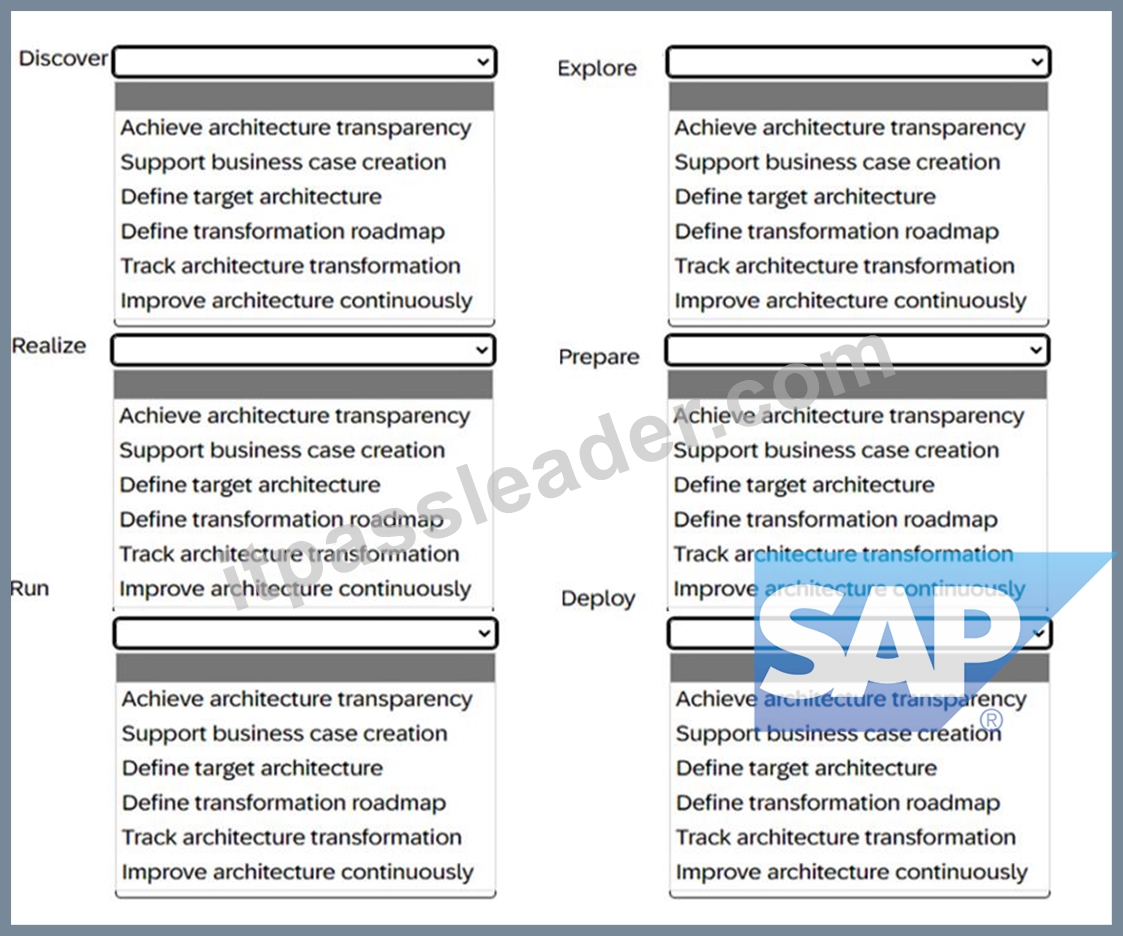
Answer:
Explanation: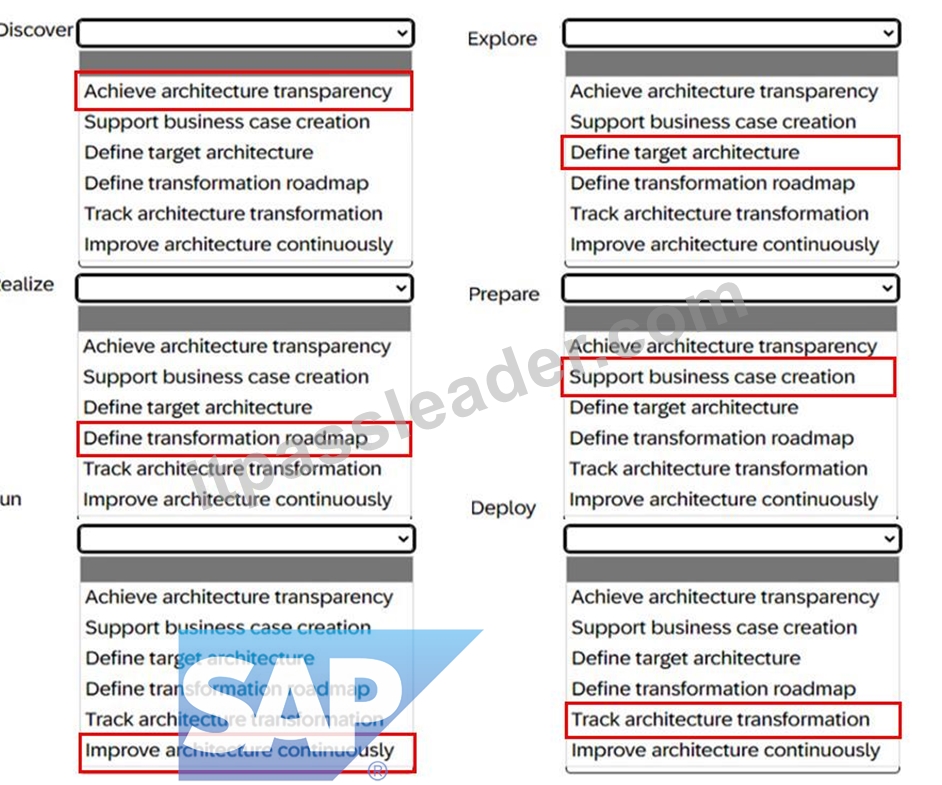
NEW QUESTION # 13
What are the key use cases of SAP AI in manufacturing?
There are 3 correct answers to this question.
Response:
- A. Handwritten production reports
- B. AI-powered production scheduling
- C. Automated quality control
- D. Manual equipment failure analysis
- E. AI-driven predictive maintenance
Answer: B,C,E
NEW QUESTION # 14
How does SAP AI support HR operations?
There are 2 correct answers to this question.
Response:
- A. Predictive workforce analytics
- B. Legacy payroll processing without AI integration
- C. Manual job application sorting
- D. AI-powered recruitment and candidate screening
Answer: A,D
NEW QUESTION # 15
What are the benefits of SAP AI-driven predictive analytics?
There are 3 correct answers to this question.
Response:
- A. Automated anomaly detection
- B. Future trend forecasting
- C. Increased manual data entry
- D. Real-time decision-making insights
- E. Manual invoice processing
Answer: A,B,D
NEW QUESTION # 16
Which SAP solution helps businesses calculate and report the carbon footprint of their products?
Please choose the correct answer.
Response:
- A. SAP Product Footprint Management
- B. SAP Cloud Platform Integration
- C. SAP Sales and Distribution
- D. SAP BusinessObjects Financial Consolidation
Answer: A
NEW QUESTION # 17
Which component of SAP AI is responsible for automating routine business tasks?
Please choose the correct answer.
Response:
- A. SAP Intelligent RPA
- B. SAP Conversational AI
- C. SAP AI Core
- D. SAP S/4HANA Cloud
Answer: A
NEW QUESTION # 18
(What are some ways that Joule revolutionizes how users can interact with SAP business systems? Note: There are 3 correct answers to this question.)
- A. Faster work
- B. Perfect predictions
- C. Smarter insights
- D. Better control
- E. Better outcomes
Answer: A,C,E
Explanation:
Comprehensive and Detailed Explanation From Exact Extract: Joule revolutionizes user interactions with SAP business systems by delivering better outcomes through connected, cross-enterprise AI agents; providing smarter insights via context-aware, data-grounded responses; and enabling faster work by streamlining tasks and accelerating processes up to 80-90% more efficiently. These capabilities transform productivity, decision-making, and efficiency without claiming perfect predictions or enhanced control as primary revolutions.
Exact extracts supporting this:
"Joule revolutionizes how you interact with your SAP business systems, making every touch-point count and every task simpler."help.sap.com
"Faster Work: Streamline tasks with an AI ..."learning.sap.com "enables employees to work 80% more efficiently."community.sap.com For better outcomes and smarter insights: "Collaborative AI agents in Joule, working across the business to deliver connected, cross-enterprise outcomes" and "offer intelligent suggestions."news.sap.com sap.com Other options are incorrect because:
Option B: Better control is not emphasized as a revolutionary aspect; Joule focuses on simplification and automation rather than increased user control.
Option C: Perfect predictions are not claimed; SAP Business AI prioritizes reliable, data-grounded insights over infallible predictions.
Reference from Positioning SAP Business AI Solutions as part of SAP Business Suite documents or Study Guide: Based on SAP product page "Joule Copilot from SAP" and SAP Learning course "Discovering SAP Business AI," explaining key capabilities like faster work, smarter insights, and better outcomes. Additional support from SAP News articles on Joule, positioned within the C_BCBAI_2502 certification for articulating Joule's transformative role in SAP Business Suite interactions.
NEW QUESTION # 19
Which of the following are features of the clean core dashboard? Note: There are 2 correct answers to this question.
- A. It can be accessed by using SAP For Me
- B. Customers can use the dashboard in the dev, test, and production tenants
- C. Customers can grant access to the dashboard to partners
- D. It can be used in all SAP S/4HANA Cloud editions
Answer: A,C
Explanation:
The SAP clean core dashboard provides tools to monitor and manage clean core compliance in SAP S
/4HANA Cloud environments. The correct answers are "Customers can grant access to the dashboard to partners" and "It can be accessed by using SAP For Me," as these are documented features of the clean core dashboard.
SAP documentation states: "The clean core dashboard in SAP S/4HANA Cloud enables customers to monitor system compliance with clean core principles, ensuring minimal customizations and seamless upgrades. It can be accessed through SAP For Me, providing a centralized interface for system management." Additionally,
"customers can grant access to the dashboard to partners," allowing external consultants or service providers to collaborate on maintaining clean core standards. This feature supports "transparent collaboration" and ensures alignment with SAP's extensibility guidelines.
The incorrect options are not features of the clean core dashboard. The dashboard is not explicitly documented as available in "dev, test, and production tenants," as its primary use is in production systems for monitoring live environments. The option "It can be used in all SAP S/4HANA Cloud editions" is incorrect, as the dashboard's availability may vary depending on specific editions (e.g., public vs. private cloud). SAP's clean core strategy documentation confirms the selected features as key capabilities of the dashboard.
NEW QUESTION # 20
Which AI-driven features in SAP S/4HANA Finance help organizations optimize financial processes? Note:
There are 2 correct answers to this question.
- A. Manual financial workflow management
- B. Predictive customer support
- C. AI-driven anomaly detection for financial fraud
- D. Intelligent invoice processing automation
Answer: C,D
Explanation:
SAP S/4HANA Finance integrates AI-driven features to streamline and secure financial processes, with AI- driven anomaly detection for financial fraud and intelligent invoice processing automation being key capabilities. These are explicitly documented as core functionalities within SAP S/4HANA Finance.
SAP documentation states: "SAP S/4HANA Finance leverages AI to optimize financial processes through capabilities like anomaly detection and intelligent automation. For example, SAP Cash Application revolutionizes payment advice processing by intelligently extracting key payment details from unstructured PDF documents." This describes intelligent invoice processing automation, which reduces manual effort and improves accuracy in financial reconciliation. Additionally, SAP S/4HANA Finance uses "AI-assisted anomaly detection" to identify potential fraud in financial transactions, enabling organizations to "proactively address risks and mitigate financial losses." This is supported by solutions like SAP Collections Management, which uses AI to prioritize high-risk accounts.
The incorrect options-manual financial workflow management and predictive customer support-are not AI- driven. Manual financial workflow management contradicts SAP's automation focus, and predictive customer support is a customer experience function, not a financial process. SAP's emphasis on AI in finance, as seen in case studies like SAP Cash Application, confirms the relevance of the selected features.
NEW QUESTION # 21
Which key advantage does SAP Business AI provide to organizations? Please choose the correct answer.
- A. Predictive insights for decision-making
- B. Automated financial accounting processes
- C. Isolated data storage without AI integration
- D. Manual business process execution
Answer: A
Explanation:
SAP Business AI delivers a transformative advantage by embedding AI into business processes to enhance decision-making. The correct answer is "Predictive insights for decision-making," as this is a core advantage highlighted across SAP's AI offerings.
SAP documentation emphasizes: "SAP Business AI offers capabilities such as predictive analytics, natural language processing, and machine learning to enhance decision-making, provide personalized insights, ensure intelligent automation of tasks, and improve business processes within the SAP ecosystem." Predictive insights enable organizations to "forecast trends, optimize operations, and make data-driven decisions" across functions like finance, supply chain, and marketing. For example, SAP S/4HANA uses predictive analytics to
"forecast expected incoming payments," while SAP Customer Experience leverages AI to predict customer behavior for targeted campaigns. Henkel's use of SAP Business Technology Platform with AI illustrates how predictive insights drive supply chain resilience and operational efficiency.
The incorrect options do not reflect SAP Business AI's core advantages. Automated financial accounting processes are a specific use case, not the primary advantage. Manual business process execution contradicts SAP's automation focus. Isolated data storage without AI integration is contrary to SAP's integrated, AI- driven architecture. Predictive insights stand out as the overarching advantage, as they enable proactive and informed decision-making across the enterprise.
NEW QUESTION # 22
Which SAP module focuses on workplace safety and environmental compliance? Please choose the correct answer.
- A. SAP Environment, Health, and Safety (EHS)
- B. SAP Predictive Analytics
- C. SAP Business Network
- D. SAP Financial Closing Cockpit
Answer: A
Explanation:
SAP Environment, Health, and Safety (EHS) is the dedicated module for managing workplace safety and environmental compliance, ensuring organizations meet regulatory and sustainability standards. The correct answer is SAP Environment, Health, and Safety (EHS), as it is explicitly designed for this purpose.
SAP documentation states: "SAP Environment, Health, and Safety (SAP EHS) supports companies in managing workplace safety, environmental compliance, and sustainability initiatives. It helps organizations comply with global regulations, ensure safe working conditions, and track environmental performance." SAP EHS enables companies to "monitor workplace incidents, manage safety protocols, and report on environmental compliance," such as emissions and waste management, to meet regulatory requirements. For example, it supports "tracking and reporting environmental data" to ensure adherence to standards, aligning with SAP's sustainability-focused solutions.
The incorrect options are unrelated to workplace safety and environmental compliance. SAP Business Network focuses on supplier collaboration and procurement, not safety or compliance. SAP Financial Closing Cockpit is used for financial reporting, not environmental or safety management. SAP Predictive Analytics supports forecasting and trend analysis, not compliance. SAP EHS is the clear choice for this purpose, as confirmed by its role in SAP's sustainability portfolio.
NEW QUESTION # 23
Which AI-driven capabilities are available in SAP Business AI?
There are 2 correct answers to this question.
Response:
- A. AI-powered fraud detection in finance
- B. Data input automation without AI involvement
- C. Machine Learning (ML) for automated data processing
- D. Manual reconciliation of financial transactions
Answer: A,C
NEW QUESTION # 24
(What are some characteristics of trustworthy business AI? Note: There are 3 correct answers to this question.)
- A. Resourcefulness
- B. Reliability
- C. Relevance
- D. Reusability
- E. Responsibility
Answer: B,C,E
Explanation:
Comprehensive and Detailed Explanation From Exact Extract: Characteristics of trustworthy business AI include responsibility through ethical governance and accountability, reliability via accurate and secure operations, and relevance by grounding in business data and contexts. These ensure AI is human-centered, transparent, and beneficial for enterprise use.
Exact extracts supporting this:
"These three "R"s - relevance, reliability, responsibility - are the cornerstones of trustworthy AI for the business world."news.sap.com Responsibility: "SAP Business AI is... responsible."learning.sap.com Reliability: "Reliable: built on best technology and partnerships."news.sap.com Relevance: "Relevant: grounded in business data."news.sap.com Other options are incorrect because:
Option B: Resourcefulness is not a defined characteristic; focus is on the three R's.
Option C: Reusability may apply to models but is not a core trustworthiness trait; emphasis is on ethics and accuracy.
Reference from Positioning SAP Business AI Solutions as part of SAP Business Suite documents or Study Guide: Derived from SAP News "Trustworthy AI Can Reinvent Companies" and SAP Learning "Introducing SAP Business Artificial Intelligence," which define trustworthy AI via relevance, reliability, and responsibility, aligned with C_BCBAI_2502 certification.
NEW QUESTION # 25
(What is Deep Learning?)
- A. A subset of AI that focuses on enabling computer systems to learn and improve from experience or data, incorporating elements from fields like computer science, statistics, and psychology.
- B. AI systems that use self-supervised learning on vast data to perform a variety of tasks, such as writing documents or creating images.
- C. A technology that equips machines with human-like capabilities such as problem-solving, visual perception, speech recognition, decision-making, and language translation.
- D. A branch of Machine Learning that uses multi-layered neural networks to analyze complex data patterns that may employ different learning methods.
Answer: D
Explanation:
Comprehensive and Detailed Explanation From Exact Extract: Deep Learning is a branch of Machine Learning that utilizes multi-layered neural networks to analyze and interpret complex data patterns, often employing various learning methods such as supervised, unsupervised, or reinforcement learning. This distinguishes it from broader AI definitions, general machine learning, or specific foundation model applications.
Exact extracts supporting this:
"Deep learning is the specialized subtype of machine learning that processes and interprets the complex inputs, including visual data from ..."sap.com
"Deep learning (DL) is a data-centric subset of machine learning that uses neural networks with multiple (deep) layers to learn and extract features from ..."sap.com
"Unlike machine learning algorithms that rely heavily on structured data inputs, deep learning models can effectively process unstructured data ..."community.sap.com Other options are incorrect because:
Option A: This describes artificial intelligence (AI) in general, which encompasses human-like capabilities across various domains.
Option B: This defines machine learning (ML), the broader field focused on learning from data without explicit programming.
Option D: This refers to foundation models or generative AI systems that use self-supervised learning for multi-modal tasks.
Reference from Positioning SAP Business AI Solutions as part of SAP Business Suite documents or Study Guide: Sourced from the official SAP resource "What is deep learning? | SAP" and SAP Learning course "Summarizing AI," which position deep learning as a subset of machine learning within SAP Business AI frameworks. Additional support from SAP Community blogs on understanding AI, ML, and DL, aligned with C_BCBAI_2502 certification materials for explaining AI concepts in business contexts.
NEW QUESTION # 26
In Custom Al Adoption (CAIA) with SAP, what is the correct order of steps?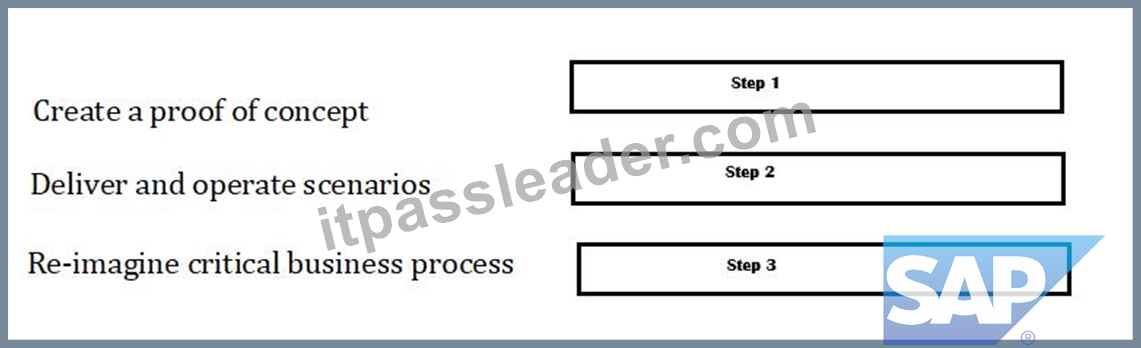
Answer:
Explanation: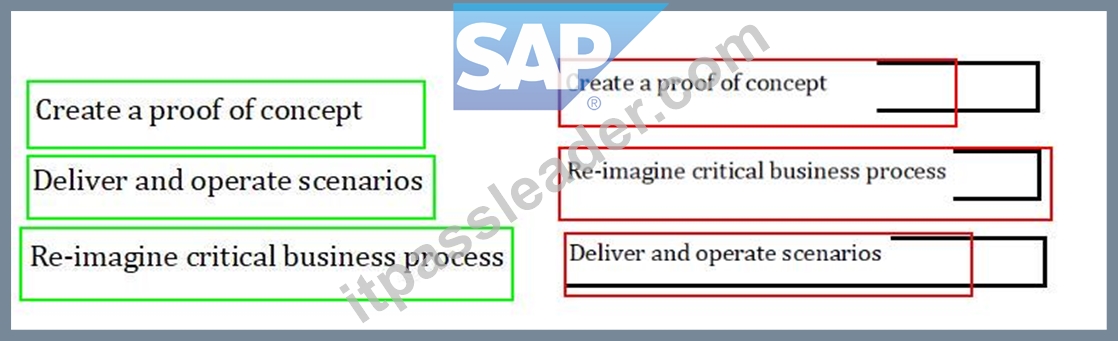
NEW QUESTION # 27
(What are some potential benefits of using SAP Business AI in finance? Note: There are 3 correct answers to this question.)
- A. Simplify error resolution
- B. Enforce compliance
- C. Reduce sales outstanding
- D. Generate creative accounting solutions
- E. Guard against fraud
Answer: A,B,E
Explanation:
Comprehensive and Detailed Explanation From Exact Extract: SAP Business AI in finance provides benefits such as enforcing compliance through risk management and governance, guarding against fraud via anomaly detection, and simplifying error resolution with intelligent guidance in processes like invoice matching and payment clarification. These capabilities enhance accuracy, reduce risks, and improve operational efficiency in financial operations.
Exact extracts supporting this:
Enforce compliance: "With SAP AI-powered governance, compliance, and risk management solutions, finance departments can identify and respond to risks as they arise."learning.sap.com "Optimize working capital, manage risk, ensure compliance, and grow revenue."sap.com Guard against fraud: "AI-assisted anomaly detection to protect the business against fraud."learning.sap.com "Reduce revenue losses due to fraud using AI with SAP Business Integrity Screening for SAP S/4HANA Cloud Private Edition."sap.com Simplify error resolution: "Intelligent guidance to simplify error resolution."learning.sap.com "Eliminate manual payment clarifications, reducing accounts receivable matching effort by 71% with AI-powered matching and payment advice extraction."sap.com Other options are incorrect because:
Option A: SAP Business AI focuses on reliable, data-grounded solutions rather than "creative" accounting, which could imply non-compliant or unethical practices.
Option D: While AI optimizes working capital, reducing days sales outstanding (DSO) is more directly associated with cash application automation, but the primary benefits highlighted are compliance, fraud protection, and error simplification; DSO reduction is a secondary outcome.
Reference from Positioning SAP Business AI Solutions as part of SAP Business Suite documents or Study Guide: Sourced from the SAP Learning Journey "Discovering New AI Capabilities for SAP Finance" and the SAP product page for "SAP Business AI - Artificial Intelligence for ERP & Finance." These emphasize AI's role in compliance, fraud detection, and error resolution within financial processes, as aligned with C_BCBAI_2502 certification materials.
NEW QUESTION # 28
(What are some unique selling propositions of SAP Business AI? Note: There are 3 correct answers to this question.)
- A. In-depth knowledge of business processes across various industries
- B. Development of SAP-specific large language models
- C. Focus on the technology stack
- D. Direct access to pertinent customer business data
- E. Robust partner ecosystem with synergistic collaboration
Answer: A,D,E
Explanation:
Comprehensive and Detailed Explanation From Exact Extract: Unique selling propositions of SAP Business AI include direct access to pertinent customer business data for grounding AI in enterprise contexts, a robust partner ecosystem enabling synergistic collaborations with industry leaders for innovation, and in-depth knowledge of business processes across industries to deliver domain-specific AI solutions. These propositions emphasize SAP's strengths in data integration, partnerships, and process expertise over generic AI technologies.
Exact extracts supporting this:
Direct access to business data: "SAP's main differentiators are - it's access to business data, understanding of the context of complex business processes, and deep domain and industry expertise."community.sap.com Robust partner ecosystem: "SAP Business AI serves as a key differentiator for Service Partners and offers a wide range of business opportunities."sap.com "Unparalleled collaborations with leading general-purpose AI technology providers."news.sap.com In-depth knowledge of business processes: "Understanding of the context of complex business processes, and deep domain and industry expertise."community.sap.com Other options are incorrect because:
Option B: While SAP has a strong technology stack, the focus is on business outcomes rather than the stack itself as a unique proposition; differentiators are data, processes, and ecosystem.
Option D: SAP does not develop its own large language models but partners with providers like Microsoft, Google, and Cohere for LLMs, emphasizing integration over proprietary development.
Reference from Positioning SAP Business AI Solutions as part of SAP Business Suite documents or Study Guide: From SAP Learning course "Discovering SAP Business AI," unit "Articulating the Value of SAP Business AI," and SAP Community blog "Generative AI with SAP - Part 1." These highlight access to data, process knowledge, and partnerships as USPs, per C_BCBAI_2502 materials.
NEW QUESTION # 29
......
Exam Sure Pass SAP Certification with C_BCBAI_2502 exam questions: https://troytec.itpassleader.com/SAP/C_BCBAI_2502-dumps-pass-exam.html