

[Sep 09, 2025] Get Latest and 100% Accurate 1z0-1065-24 Exam Questions
Maximum Grades By Making ready With 1z0-1065-24 Dumps
NEW QUESTION # 11
Your customer is importing supplier data into the application and wants to be able to create supplier content map sets to support the import.
Which three values can be included in the map set?
- A. Item
- B. Category
- C. Catalog
- D. UOM
- E. Supplier
Answer: B,D,E
NEW QUESTION # 12
You have the following business requirements when creating an implementation project:
You want to see the list of offerings and functional areas that are configured for the project.
You want to identify at which stage all offerings and functional areas are.
Which two fulfill these requirements?
- A. Change Provisioned to "No" to specify the offering that you want to select while creating an implementation project.
- B. Select the Enable check box to specify the options.
- C. After creating the implementation project, set the status of tasks to in Progress or Implemented.
- D. Although the offering configuration can be changed at any time, the changes will influence any existing implementation task lists.
- E. You need the IT Security role to fulfill these requirements.
Answer: B,C
Explanation:
When you create an implementation project, you can select the offerings and functional areas that you want to implement by selecting the Enable check box for each option. This will generate a list of setup tasks for the selected options. You can also see the status of each offering and functional area, such as Provisioned, Enabled, or Not Enabled. After creating the implementation project, you can update the status of each task to indicate the progress of the implementation. You can set the status to In Progress, Implemented, or Not Applicable. This will help you to identify the stage of each offering and functional area in the implementation project.
References:
* How You Use Implementation Projects to Manage Setup
* Oracle Fusion Applications Procurement Implementation Guide, Section 2.1: "Create Implementation Project"
NEW QUESTION # 13
uring discussions your client indicates that as they are a contract manufacturer, they need to execute supply chain activities in the context of projects.
In which offering can you opt in to a feature that enables this?
- A. Project Execution Management
- B. Manufacturing and Supply Chain Materials Management
- C. Project Financial Management
Answer: B
NEW QUESTION # 14
During your implementation discussions, your client wants to use the procurement offering to create negotiations and make best-value award decisions. They also wish to be able to monitor their supplier's performance regularly to confirm that they are supplying consistent quality of materials, components and services in compliance with regulatory requirements.
Which functional areas would you use to achieve this?
- A. Sourcing, Supplier Qualification, and Procurement Contracts
- B. Sourcing, Supplier Qualification, and Procurement Foundation
- C. Sourcing, Supplier Qualification, and Negotiations
- D. Sourcing, Supplier Qualification, and Purchasing
- E. Sourcing, Supplier Qualification
Answer: C
NEW QUESTION # 15
To streamline negotiation communication between your organization and your suppliers, you have opted in to the Share Enterprise Contracts feature in Supplier Portal.
Under which three conditions can you access this feature?
- A. The contract is of Sell intent.
- B. The contract is in Draft status.
- C. The contract is in Active status.
- D. The contract is in Under amendment status.
- E. The contract is of Buy intent.
Answer: B,C,E
Explanation:
The Share Enterprise Contracts feature in Supplier Portal allows you to share contracts with your suppliers and collaborate on contract terms and deliverables. You can access this feature under the following conditions:
* The contract is in Active status: This means that the contract has been approved and accepted by both parties and is ready for execution. You can share the contract with your supplier to monitor the contract fulfillment and performance1.
* The contract is of Buy intent: This means that the contract is a procurement contract that governs the purchase of goods or services from a supplier. You can share the contract with your supplier to negotiate the contract terms and conditions2.
* The contract is in Draft status: This means that the contract has been created but not yet submitted for approval. You can share the contract with your supplier to solicit feedback and input on the contract content3.
References:
* Share Contracts, Section 1: "Share Contracts"
* Overview of Procurement Contracts, Section 1: "Overview of Procurement Contracts"
* Create Procurement Contracts, Section 1: "Create Procurement Contracts"
NEW QUESTION # 16
Which two tasks can a customer perform in Functional Setup Manager when configuring setup data?
- A. Importing and exporting data between instances
- B. Setting up and maintaining data by means of the Manage Admin menu
- C. Collecting data to populate the Order Orchestration and Planning Data repository
- D. Configuring Oracle Fusion Cloud applications to match business needs
Answer: A,D
NEW QUESTION # 17
Within your organization, there is a problem of notification emails not always being recognized and being moved to the spam folder.
What do you first need to configure in order to enable the options for the from and Reply to email addresses?
- A. Application Development Framework (ADF)
- B. Business-to-Business Service (B2B)
- C. Sender Policy Framework (SPF)
- D. Public Key Infrastructure (PKI)
Answer: C
Explanation:
Sender Policy Framework (SPF) is a protocol that allows the owner of a domain to specify which mail servers are authorized to send emails on behalf of that domain. This helps to prevent spoofing and phishing attacks by verifying the sender's identity. By configuring SPF for your Oracle Fusion Cloud Procurement application, you can enable the options for the from and reply to email addresses for supplier onboarding and profile management notifications. This will help your suppliers to trust the notifications and avoid them being marked as spam.
References:
* How You Configure Sender Name and Email in Supplier Management Notifications1
* Configure Purchase Order Email Approval Notifications Using Reports2
NEW QUESTION # 18
You are implementing Payables and Procurement and are ready to set up business units.
Which three common controls and default values need to be set?
- A. Expense Accruals
- B. Currency Conversion
- C. Buyer Assignments
- D. Automatic Offsets
- E. Collaborating Messaging
Answer: A,C,D
NEW QUESTION # 19
Your client's business requires that only Requester A is provided access to the punchout catalog and not Requester B.
Which configuration fulfills this requirement?
- A. Set the punchout catalog security on the Punchout Catalog Definition page to "Secured by worker" with the value Requester A and no setup for Requester B.
- B. Set the punchout catalog content zone security to "Secured by worker" with the value Requester A and no setup for Requester B.
- C. Assign the Punchout Catalog Requester role to Procurement Requester A and the Procurement Requester role to Requester B.
- D. Assign the Advanced Procurement Requester role to Requester A and the Procurement Requester role to Requester B.
Answer: B
NEW QUESTION # 20
Challenge 5
Manage Procurement Agents
Scenario:
Your procurement organization requires you to define yourself as a purchasing buyer so that you can create and manage procurement transactions.
Task
Define a Procurement Agent, where:
Procurement BU is US1 Business Unit
. Agent is mapped to your assigned Login username - Student, PRCXX (Replace xx with 01, which is your allocated User ID.)
All default procurement actions are to be assigned and accepted as-is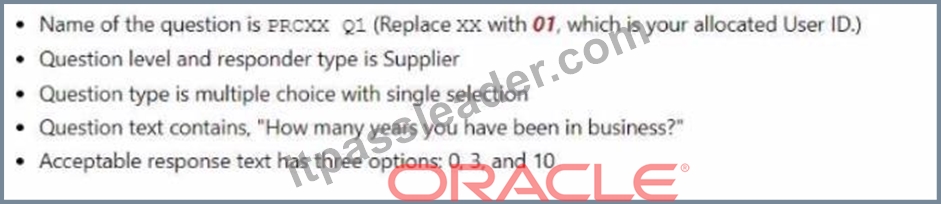
Answer:
Explanation:
See below in Explanation for each Step.
Explanation:
To define a Procurement Agent, you can follow these steps:
* Navigate to the Setup and Maintenance work area and search for the Manage Procurement Agents task.
* Click on the Go to Task icon to open the Manage Procurement Agents page.
* Click on the Create icon to create a new procurement agent.
* Enter the following information in the Create Procurement Agent dialog box:
* Procurement Business Unit: US1 Business Unit
* Agent: Student, PRC01
* Procurement Actions: Select all the check boxes to assign all the default procurement actions
* Click on the Save and Close button to save the procurement agent.
You have successfully defined a procurement agent. You can verify the procurement agent details by searching for it in the Manage Procurement Agents page. For more information on how to define and manage procurement agents, you can refer to the Define Procurement Agents (Oracle Fusion Cloud Procurement Implementation Guide) document.
Or the following steps:
Following the scenario, we need to define you (Student, PRCXX) as a Procurement Agent with access to manage procurement transactions in the US1 Business Unit.
Here are the steps to define the Procurement Agent:
* Navigate to Manage Procurement Agents:
* Go to the Global Navigation Menu.
* Click on Procurement.
* Click on Setup and Maintenance.
* Click on Procurement Agents.
* Create the Procurement Agent:
* Click on the Create icon (+ icon).
* Enter the Procurement Agent Information:
* Procurement BU: Select "US1 Business Unit".
* Agent: Enter your assigned Login username - "Student, PRCXX" (replace xx with 01).
* Requisitioning BU: (Optional) You can select a specific Requisitioning Business Unit if you primarily handle requests from that unit. Otherwise, leave it blank.
* Default Procurement Actions: Select "Use Defaults". This assigns all default procurement actions (create purchase orders, issue requisitions, etc.) to you.
* Save the Procurement Agent:
* Click on the Save button.
Verification:
* You should now be listed as a Procurement Agent in the Manage Procurement Agents page.
* You can verify your assigned actions and Business Units by clicking on your record.
* You should be able to create and manage procurement transactions within the US1 Business Unit.
Additional Notes:
* Make sure to replace "xx" with your allocated User ID (01) in the Agent field for accurate identification.
* Selecting "Use Defaults" assigns all standard procurement actions to you. You can customize these actions later if needed.
* Remember that your access level and permissions within the Procurement module will be determined by your Procurement Agent role and associated Business Units.
NEW QUESTION # 21
The Procurement Catalog Administrator can map content received from a supplier to internal values used by the application.
For which three areas can they create map sets so that they may be converted to values in the Procurement business unit?
- A. UOM
- B. Category
- C. Catalog
- D. Supplier
- E. Sourcing
Answer: B,C,D
NEW QUESTION # 22
In the Supplier Portal, which job role must you allocate to a supplier contact to enable them to provision user accounts to their own employees?
- A. Supplier Self Service Clerk
- B. Supplier Self Service Administrator
- C. Supplier Administrator
- D. Supplier Manager
Answer: A
Explanation:
The Supplier Administrator job role is the only one that can provision user accounts to their own employees in the Supplier Portal. This role allows the supplier contact to manage supplier profile and user provisioning, as well as perform other tasks related to supplier master data, supplier qualification, and supplier registration.
The other job roles do not have the privilege to create or modify supplier user accounts.
References:
* Oracle Fusion Supplier Portal Important Roles
* Supplier Administrator (Abstract Role)
* Supplier Portal Job Roles and Tasks
NEW QUESTION # 23
During a discussion about your implementation, your client mentioned that they negotiate credits for equipment trade-ins.
How can you create this in the application?
- A. Create an agreement with a credit line.
- B. Create a requisition with a negative line.
- C. Create a document style that supports credit lines.
- D. Create a purchase order template that supports credit lines.
Answer: D
Explanation:
A document style is a template that defines the layout and content of a purchasing document, such as a purchase order, a purchase agreement, or a requisition. You can create a document style that supports credit lines, which are purchase order lines with a negative amount to record credits to the ordered amount that you have negotiated with your supplier. For example, you can use a credit line to represent credit for an equipment trade-in. You can also specify other attributes for the document style, such as the line types, the change order policies, the approval rules, and the communication methods.
References:
* How You Create Purchase Order Lines with Negative Amounts
* How You Enable Creation of Purchase Order Lines with Negative Amounts
* Create Supplier Contracts from Negotiation Award
NEW QUESTION # 24
Challenge 3
Manage Purchasing Line Types
Scenario:
Your business unit requires a new line type for purchasing transactions.
Task3:
Create a new Purchasing Line Type, where:
. Name of the line type is PRCXX Computer Goods (Replace xx with 01, which is your allocated User ID.)
Code is PRCXXCOMP
. Purchase basis is quantity-based for the Goods product type
. Line type is linked to the Computer Supplies category
. Unit is Ea
Answer:
Explanation:
See below in Explanation for each Step.
Explanation:
To create a new Purchasing Line Type, you can follow these steps:
* Navigate to the Setup and Maintenance work area and search for the Manage Purchasing Line Types task.
* Click on the Go to Task icon to open the Manage Purchasing Line Types page.
* Click on the Create icon to create a new line type.
* Enter the following information in the Create Line Type dialog box:
* Name: PRC01 Computer Goods
* Code: PRC01COMP
* Purchase Basis: Quantity
* Product Type: Goods
* Category: Computer Supplies
* Unit of Measure: Ea
* Click on the Save and Close button to save the line type.
You have successfully created a new Purchasing Line Type. You can verify the line type details by searching for it in the Manage Purchasing Line Types page. For more information on how to define and use line types, you can refer to the Defining Line Types (Oracle Purchasing Help) document.
Or use the following:
Following the scenario, we need to create a new Purchasing Line Type in Oracle Procurement Cloud named
"PRCXX Computer Goods" (replace xx with 01) for purchasing computer supplies.
Here are the steps to create the Purchasing Line Type:
* Navigate to Manage Purchasing Line Types:
* Go to the Global Navigation Menu.
* Click on Procurement.
* Click on Setup and Maintenance.
* Click on Purchasing Line Types.
* Create the Purchasing Line Type:
* Click on the Create icon (+ icon).
* Enter the Purchasing Line Type Information:
* Name: Enter "PRCXX Computer Goods" (replace xx with 01).
* Code: Enter "PRCXXCOMP".
* Purchase Basis: Select "Quantity-Based".
* Product Type: Select "Goods".
* Category: Select "Computer Supplies".
* Unit: Enter "Ea" (for Each).
* Description: (Optional) Enter a brief description of the line type.
* Map Accounts:
* Click on the Map Accounts tab.
* Select the appropriate accounts for the following:
* Inventory Asset Account
* Inventory Expense Account
* Cost of Goods Sold Account
* Click on the Save and Close button.
* Save the Purchasing Line Type:
* Click on the Save button.
Verification:
* The Purchasing Line Type "PRCXX Computer Goods" (replace xx with 01) should now be listed in the Manage Purchasing Line Types page.
* You can verify the details of the line type by clicking on it.
* The purchase basis, product type, category, unit, and mapped accounts should be displayed as specified above.
Additional Notes:
* Make sure to replace "xx" with your allocated User ID (01) in both the Purchasing Line Type name and code for consistent naming convention.
* Mapped accounts define where the financial transactions associated with this line type will be posted in the General Ledger.
* Carefully review the mapped accounts to ensure they are aligned with your organization's accounting practices.
NEW QUESTION # 25
In relation to suppliers, your client has several suppliers with whom they expect to do a high volume of business over an extender period. To simplify this, it would be useful to use master contracts to set the overall terms and conditions between parties.
Which two purchasing documents can link to this type of contract?
- A. Requisitions
- B. Purchase Orders
- C. Negotiations
- D. Initiatives
- E. Agreements
Answer: B,E
NEW QUESTION # 26
Delays in supplier self-service registration can be frustrating. In your implementation, there are some regions where you want to simplify supplier self-service registration and bypass mandatory supplier identifiers.
Which task should you use to set this up?
- A. Configure Supplier Registration and Profile Change Request
- B. Manage Supplier Profile Change Request
- C. Manage Supplier Profile Options
- D. Manage Self Service Procurement Profile Options
- E. Manage Internal Supplier Registration Approvals
Answer: A
Explanation:
To simplify supplier self-service registration and bypass mandatory supplier identifiers for some regions, you should use the Configure Supplier Registration and Profile Change Request task in the Setup and Maintenance work area. This task allows you to define the registration settings for prospective and spend authorized suppliers, such as the required attributes, the approval rules, and the site assignments. You can also specify the supplier identifiers that are mandatory or optional for each country or region. For example, you can make the tax registration number optional for suppliers in a region where it is not commonly used.
References:
* Options to Configure Supplier Registration and Supplier Profile Change Request, Section 1: "Options to Configure Supplier Registration and Supplier Profile Change Request"
* Configure Supplier Registration and Profile Change Request, Section 1: "Configure Supplier Registration and Profile Change Request"
NEW QUESTION # 27
You need to set up a Procurement business unit to serve the procurement needs of various Requisitioning business units.
What must you set up in Oracle Fusion Cloud Procurement to meet this requirement?
- A. Service Provider relationship in the Requisitioning business unit setup
- B. Default Requisitioning business unit relationship in the Procurement Agent setup
- C. Spend Authorized relationship between a Supplier and a Requisitioning business unit
- D. Default Procurement BU relationship in the Requisitioning business function setup
Answer: A
Explanation:
To set up a Procurement business unit to serve the procurement needs of various Requisitioning business units, you must set up a Service Provider relationship in the Requisitioning business unit setup. This relationship defines the Procurement business unit as the service provider of the procurement business function, and the Requisitioning business units as its clients. This way, the Procurement business unit can take care of supplier negotiations, supplier site maintenance, and purchase order processing on behalf of the Requisitioning business units. The other options are not relevant for this requirement.
References:
* 1: Service Provider Models - Oracle
* 2: Implement Procurement - docs.oracle.com
* [3]: Setup Steps in Oracle Fusion Cloud Procurement
NEW QUESTION # 28
Your customer is implementing Oracle Fusion Cloud Procurement applications with multiple Requisitioning business units. Each business unit has employees who need the ability to create requisitions. The customer does not want all employees in the organization to be able to create requisitions using the self-service application; however, they should be able to search for information (for example, contact details) relating to other employees.
Which inherited role must be removed from the seeded Employee role to restrict certain employees from creating requisitions?
- A. Employee
- B. Team Collaborator
- C. Procurement Requester
- D. Contingent Worker
- E. Supplier Self Service Clerk
Answer: C
NEW QUESTION # 29
How does the Al-enhanced spend classification process improve procurement efficiency?
- A. By generating purchase requisitions
- B. By automating supplier negotiations
- C. By enhancing accuracy in categorizing spend transactions
Answer: C
NEW QUESTION # 30
When companies are evolving, there are often mergers or acquisitions. You want the supplier contacts of the parent company to be able to only respond to the negotiations of the subsidiaries to which they have access to.
What is the setup to achieve this?
- A. Parent company supplier must be added to the supplier profile of the subsidiary company.
- B. Subsidiary company must forward the negotiation to the parent company supplier to respond.
- C. Parent company supplier must be added to the negotiation.
- D. Subsidiary company supplier must request for the company supplier contact to be added to the negotiation.
Answer: A
NEW QUESTION # 31
When discussing potential supplier qualification questions, the customer would like to be able to map questions directly to supplier profile information.
Which two attributes can be mapped to questions in the supplier profile?
- A. Receipts
- B. Agreements
- C. Corporate Profile
- D. Income Tax
- E. Catalogs
Answer: C,D
NEW QUESTION # 32
Your Organization now wishes to access Responsive self service procurement application from the navigator or the springboard on all form such as mobile phones, tablets and laptop devices ?
After opting in which search setup needs to be completed.
- A. Wildcard
- B. Stemming
- C. Fuzzy
- D. Elastic
Answer: D
NEW QUESTION # 33
You are implementing Procurement Contracts and, during user acceptance testing, a user wants to create clauses in the Fusion Cloud application similar to what were available in their legacy contract application.
What are two ways to create clauses to meet this requirement?
- A. Create Clauses from the Contracts Work Area page
- B. Import Clauses from the Contracts work area page
- C. Manage Contract Standard Clauses from Functional Setup Manager
- D. Manage Contract Standard Clauses, Templates, and Profiles from Functional Setup Manager
Answer: A,B
NEW QUESTION # 34
......
Oracle 1z0-1065-24 Exam Syllabus Topics:
| Topic | Details |
|---|---|
| Topic 1 |
|
| Topic 2 |
|
| Topic 3 |
|
| Topic 4 |
|
| Topic 5 |
|
| Topic 6 |
|
| Topic 7 |
|
| Topic 8 |
|
| Topic 9 |
|
Give push to your success with 1z0-1065-24 exam questions: https://troytec.itpassleader.com/Oracle/1z0-1065-24-dumps-pass-exam.html