

[UPDATED 2026] Getting CIFC Certification Made Easy!
CIFC Exam Crack Test Engine Dumps Training With 225 Questions
IFSE Institute CIFC Exam Syllabus Topics:
| Topic | Details |
|---|---|
| Topic 1 |
|
| Topic 2 |
|
| Topic 3 |
|
| Topic 4 |
|
| Topic 5 |
|
NEW QUESTION # 62
On January 3, John invests $500 in the Blue Sky U.S. Equity Fund. On July 1 of the same year, he invests another $500 into the same mutual fund. Information about the net asset value per unit (NAVPU) at the time of each transaction is provided below. Given this information, what will be the value of John's investment on December 31 of this year (please ignore transaction costs and distributions)?
- A. $1,332
- B. $1,256
- C. $1,198
- D. $1,216
Answer: B
Explanation:
Explanation
The value of John's investment on December 31 of this year can be calculated by multiplying the number of units he holds by the net asset value per unit (NAVPU) on that date. Since John invested $500 on January 3 and $500 on July 1, he holds a total of 125.6 units (62.8 units from the first investment and 62.8 units from the second investment). Therefore, the value of his investment on December 31 will be 125.6 units x $9.55 NAVPU = $1,256.
References: Canadian Investment Funds Course, Chapter 2: Mutual Funds1
NEW QUESTION # 63
The Mutual Fund Dealers Association of Canada (MFDA) has strict rules concerning conflicts of interest.
Which of the following is TRUE?
- A. Gifts and benefits may be provided to a client if your employer is aware of the benefits and has given approval.
- B. Borrowing money from a client will always be acceptable provided there is a written contract detailing the nature of the agreement.
- C. Activities that do not relate specifically to your employer need not be reported.
- D. Only actual conflicts must be reported to your employer. Potential conflicts need not be reported because they have not happened yet.
Answer: A
NEW QUESTION # 64
What role do investment dealers play in the Canadian and global financial markets?
- A. They are contributors to a company's profits.
- B. They assist with the exchange of capital for a financial instrument.
- C. They are contributors to an investor's earnings.
- D. By underwriting financial instruments, they raise capital for investors.
Answer: B
NEW QUESTION # 65
Portia is a Dealing Representative with Highview Wealth Inc., a mutual fund dealer. Portia recommends the Stature Growth Fund to her client Clive. Which of the following CORRECTLY describes what Portia must do in order to satisfy her obligations under the Client Relationship Model (CRM) and Client Focused Reforms (CFR)?
- A. Portia must mark the trade as ^unsolicited" if Clive wants to proceed with the trade and it is not suitable for him.
- B. Portia must calculate the net asset value per unit (NAVPU) and report it to Give in the trade confirmation.
- C. Portia must provide Clive with the pre-trade disclosure to address any material conflicts of interest with the trade.
- D. Portia must disclose the costs, expenses, and ongoing fees associated with the investment prior to the trade.
Answer: D
NEW QUESTION # 66
Based on your discussions with your client Sierra, you believe an asset allocation of 30% fixed income and
70% equities will help her achieve her long-term goals. What type of asset allocation strategy are you implementing?
- A. lifecycle
- B. tactical
- C. strategic
- D. optimal
Answer: C
Explanation:
Explanation
A strategic asset allocation strategy is one that involves setting target allocations for various asset classes based on the investor's risk tolerance, time horizon, and investment objectives, and rebalancing the portfolio periodically to maintain the original allocations. This strategy is compatible with a buy-and-hold approach and aims to achieve long-term goals by diversifying across different asset classes and markets. In this case, you are implementing a strategic asset allocation strategy for your client Sierra by assigning 30% of her portfolio to fixed income and 70% to equities, and planning to rebalance her portfolio when the actual allocations deviate significantly from the target allocations.
References: Canadian Investment Funds Course, Unit 7, Section 7.1
NEW QUESTION # 67
Danny is a Dealing Representative for Everbright Investments. He met with his client Adele, who has
$1,000,000 to invest. During their meeting Danny determines that Adele has a high-risk profile. In addition, he learns that she has an excellent understanding of equities and how volatile they can be. Danny is considering recommending growth funds specifically, and making a recommendation from the following investment options:
Based on the information provided, which mutual fund should Danny recommend?
- A. ABC Global Equity Fund.
- B. DEF European Equity Fund.
- C. Invest equally in all 3 funds.
- D. LMN Asia Pacific Equity Fund.
Answer: C
Explanation:
Explanation
Adele has a high-risk profile and an excellent understanding of equities. Therefore, it would be appropriate for Danny to recommend growth funds. However, since Adele has $1,000,000 to invest, it would be prudent to diversify her investments and invest equally in all 3 funds. This way, she can benefit from the exposure to different regions and sectors, and reduce the impact of market fluctuations on her portfolio. Based on the table, all 3 funds have the same 5-year annualized returns net of MER, which is 15%. However, they have different MERs and Sharpe ratios. The MER is the fee charged by the fund manager for managing the fund, and the Sharpe ratio is a measure of risk-adjusted return. A lower MER means a lower cost for the investor, and a higher Sharpe ratio means a higher return per unit of risk. Therefore, investing equally in all 3 funds would allow Adele to achieve a balanced trade-off between cost and performance. References:
Canadian Investment Funds Course (CIFC) Study Guide, Chapter 4: Mutual Funds, Section 4.2: Types of Mutual Funds, page 4-6 Canadian Investment Funds Course (CIFC) Study Guide, Chapter 5: Fixed-Income Securities, Section
5.5: Risk-Return Trade-Offs, page 5-14
Sharpe Ratio Definition - Investopedia
NEW QUESTION # 68
Which of the following statement about Exchange Traded Funds (ETFs) is TRUE?
- A. Usually the market price of an ETF is the net asset value per unit (NAVPU) of the Fund on that day.
- B. All ETFs are actively managed.
- C. ETFs have lower MERs compared to mutual funds.
- D. Investors may sell their ETFs in the stock market or redeem them through the Fund at the NAVPU of the day.
Answer: C
NEW QUESTION # 69
Sean purchases 500 units of Penn Canadian Equity Fund when the net asset value per unit (NAVPU) is
$16.70. On December 15, the mutual fund's NAVPU is $21. On December 16, the mutual fund declares a distribution of $1.25 per unit. Sean's distribution is immediately reinvested and he purchases additional units of the mutual fund.
Which of the following statements about the effect of the distribution is correct?
- A. The total value of Sean's mutual fund holdings after the distribution and reinvestment is §9,875.
- B. Sean's distribution is reinvested at a NAVPU of $19.75 and he receives approximately 31.65 additional units.
- C. The NAVPU of the mutual fund does not change after the distribution since Sean reinvests his distribution and purchases additional units.
- D. After the distribution. Sean will have J&625 in cash and JB8.350 worth of the Penn Canadian Equity Fund.
Answer: B
NEW QUESTION # 70
Manuel is a Dealing Representative for Commonwealth Financial Inc., a mutual fund dealer. His dealer represents many different mutual fund families available, including their own: CF Group of Funds. He is considering recommending a CF equity fund to one of his clients, Stefania. While describing details about the fund, he informs her that accounts are set-up in nominee name, and that their mutual funds are not transferable.
In addition, the fund does pay trailer fees.
What type of information has Manuel described about his potential investment recommendation?
- A. Features of a locked-in plan
- B. The material conflict of interest
- C. Excessive trading
- D. A Letter of Engagement
Answer: B
Explanation:
Explanation
A material conflict of interest is a situation where a dealing representative or a mutual fund dealer has an interest that may affect their ability to act in the best interest of their clients, or that may influence their judgment or behaviour. A material conflict of interest may arise from various sources, such as compensation arrangements, personal or business relationships, or ownership interests. In this case, Manuel has described some information that may indicate a material conflict of interest, such as:
*His dealer represents many different mutual fund families, including their own: CF Group of Funds. This may create a bias or incentive for Manuel to recommend the CF equity fund over other funds that may be more suitable for his client, Stefania.
*The accounts are set-up in nominee name, which means that the dealer is the registered owner of the mutual funds and holds them in trust for the client. This may affect the client's rights and benefits as the beneficial owner of the funds, such as voting rights, transferability, or access to information.
*The mutual funds are not transferable, which means that the client cannot move them to another dealer or fund family without selling them and incurring fees or taxes. This may limit the client's flexibility and choice, and create a lock-in effect for the dealer.
*The fund does pay trailer fees, which are ongoing commissions paid by the fund manager to the dealer for the services and advice provided to the client. This may create a conflict of interest for Manuel, as he may receive a portion of the trailer fees as part of his compensation. This may influence his recommendation of the fund, as he may benefit from the client's continued investment in the fund.
Manuel should disclose these potential material conflicts of interest to his client, Stefania, and explain how they may affect his recommendation of the CF equity fund. He should also ensure that his recommendation is based on the client's needs, objectives, risk tolerance, and time horizon, and that he provides the client with the necessary information and documents, such as the fund facts, to make an informed decision.
References = Canadian Investment Funds Course, Unit 7: The Regulatory Environment, Lesson 1: The Regulatory Framework, Section 7.1.3: Material Conflicts of Interest1; CIFC prepkit, Chapter 7: The Regulatory Environment, Question 7.1.3 2
NEW QUESTION # 71
Ai Fen has recently become registered to sell mutual funds with Acadian Eastern Financial, a mutual fund dealer. Ai Fen determined that with her background of being a Chartered Financial Analyst, she can help people understand the nature of investing more easily than others in her field.
Which registration category will need to be prominently noted on Ai Fen's business card to comply with the
"holding out rule"?
- A. Registered Representative
- B. Dealing Representative
- C. Investment Representative
- D. Chartered Financial Analyst
Answer: B
Explanation:
Explanation
The holding out rule is a regulatory requirement that prohibits registered individuals from using any title or designation other than their registration category when dealing with clients or potential clients. The purpose of this rule is to prevent misleading or confusing representations about the qualifications, roles, and responsibilities of registered individuals. According to Section 4.4 of National Instrument 31-103 Registration Requirements, Exemptions and Ongoing Registrant Obligations (NI 31-103), individuals who are registered to sell mutual funds must use the title "dealing representative" when holding out to clients or potential clients.
Therefore, Ai Fen must prominently note "dealing representative" on her business card to comply with the holding out rule. The other options are not valid registration categories for selling mutual funds. Option B is a generic term that does not specify the type of securities that can be sold. Option C is a registration category for individuals who trade securities on behalf of an investment dealer. Option D is a professional designation that does not indicate registration status. References: [Holding Out Rule], [Registration Categories], [Registration Requirements, Exemptions and Ongoing Registrant Obligations]
NEW QUESTION # 72
Marta is turning 71 years old this year. She will have to convert her registered retirement savings plan (RRSP) to a registered retirement income fund (RRIF). Which of the following statements is TRUE?
- A. She will be able to continue contributing to her RRIF and be subject to the same annual limits as her RRSP.
- B. She will be subject to annual maximum withdrawal limits.
- C. She does not have to withdraw the minimum amount this year.
- D. When she converts her RRSP to a RRIF, she will incur a tax liability.
Answer: C
NEW QUESTION # 73
Sean purchases 500 units of Penn Canadian Equity Fund when the net asset value per unit (NAVPU) is
$16.70. On December 15, the mutual fund's NAVPU is $21. On December 16, the mutual fund declares a distribution of $1.25 per unit. Sean's distribution is immediately reinvested and he purchases additional units of the mutual fund.
Which of the following statements about the effect of the distribution is correct?
- A. The total value of Sean's mutual fund holdings after the distribution and reinvestment is $9,875.
- B. Sean's distribution is reinvested at a NAVPU of $19.75 and he receives approximately 31.65 additional units.
- C. The NAVPU of the mutual fund does not change after the distribution since Sean reinvests his distribution and purchases additional units.
- D. After the distribution. Sean will have J&625 in cash and JB8.350 worth of the Penn Canadian Equity Fund.
Answer: B
Explanation:
Explanation
Sean's distribution is reinvested at a NAVPU of $19.75 and he receives approximately 31.65 additional units.
When a mutual fund declares a distribution, it reduces its NAVPU by the amount of the distribution per unit.
In this case, the NAVPU drops from $21 to $19.75 after the distribution of $1.25 per unit. Sean's distribution is $625 ($1.25 x 500 units), which he reinvests in the mutual fund at the new NAVPU of $19.75. He receives
additional units. The total value of Sean's mutual fund holdings after the distribution and reinvestment is (500+31.65)*19.75=$10,500
, not $9,875. The NAVPU of the mutual fund does change after the distribution, regardless of whether Sean reinvests his distribution or not. References: [Unit 7: Mutual Funds Administration]
NEW QUESTION # 74
David had $10,000 in his investment account with Dynamic Investments, a mutual funds dealer. On June 28, David wants to buy 500 units in ABC Canadian Dividend Fund that has a Net Asset Value Per Unit (NAVPU) of $14.10. His friend Robert suggests that he may get a better price if he used the strategy of dollar-cost averaging. David then instructs his Dealing Representative to place a purchase order for 100 units on the first of every month starting July 1st for the next 5 months.
The orders are executed at the following NAVPUs.
July 01, $14.00
Aug. 01, $14.50
Sep. 01, $15.00
Oct. 01, $14.25
Nov. 01, $16.50
Did David get a better purchase price following the dollar-cost averaging strategy compared to making a lump-sum purchase of 500 shares on Jun 28, 20xx?
- A. David got his 500 units at a higher price than the lump sum price he would have paid
- B. David realizes that Dollar cost averaging is the best strategy for getting lower prices.
- C. David got his 500 units at the same price as the lump sum price he would have paid.
- D. David got his 500 units at a lower price than the lump sum price he would have paid.
Answer: A
NEW QUESTION # 75
At 4:00 p.m. Eastern Time on July 6, the following information is collected for the Marigold Canadian Dividend Fund: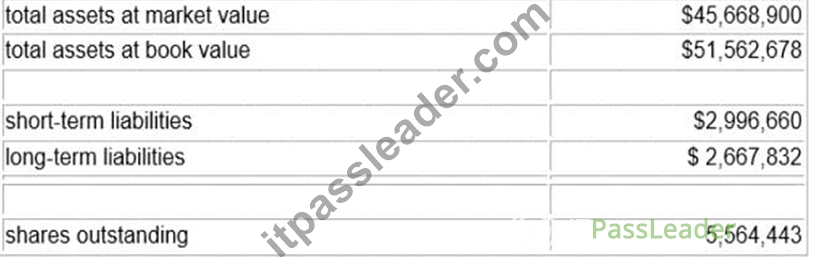
What is the net asset value per unit NAVPU for the Marigold Canadian Dividend Fund for July 6?
- A. $9.27
- B. $7.65
- C. $8.25
- D. $7.19
Answer: C
Explanation:
Explanation
This is the net asset value per unit (NAVPU) for the Marigold Canadian Dividend Fund for July 6. The NAVPU is calculated by dividing the net asset value (NAV) of the fund by the number of units outstanding. In this case, the NAVPU is $8.25 ($45,668,900 / 5,564,443).
The NAV is the value of a fund's assets minus the value of its liabilities. The value of assets is the value of all the securities in the portfolio, plus any cash and cash equivalents, plus any accrued income for the day. The value of liabilities is the value of all short-term and long-term liabilities, plus any accrued expenses for the day. The NAV is usually expressed on a per-share or per-unit basis, which is the NAVPU.
The NAVPU is the price at which investors can buy or sell units of the fund. It is determined at the end of each trading day based on the closing market prices of the portfolio's securities. The NAVPU can change daily depending on the performance of the securities in the fund and the fund's expenses.
NEW QUESTION # 76
Which of the following statements about total return for money market funds is TRUE?
- A. Current yield incorporates the compounding effect.
- B. Current yield reflects the income earned on a money market fund for the most recent 14 day period.
- C. Effective yield will always be lower than current yield.
- D. Performance is displayed with both current yield and effective yield.
Answer: D
Explanation:
Explanation
Current yield and effective yield are two ways of measuring the total return for money market funds. Current yield reflects the income earned on a money market fund for the most recent 14 day period, annualized.
Effective yield incorporates the compounding effect of reinvesting the income earned on a money market fund over a year. Both current yield and effective yield are displayed in the performance reports of money market funds, as they provide different information to investors.
References = Canadian Investment Funds Course, Unit 5: Types of Investments, Lesson 4: Money Market Instruments, Section 5.4.3: Total Return for Money Market Funds1; CIFC prepkit, Chapter 5: Types of Investments, Question 5.4.3 2
NEW QUESTION # 77
Frederic recently sold his units in a US dollar (USD) denominated mutual fund. He wants to convert the proceeds back to Canadian dollars (CAD). If he received proceeds of $1,200 USD from the sale and the exchange rate is $1 CAD for $0.99 USD, how much will Frederic receive in Canadian dollars?
- A. $1, 12.12
- B. $1-188.00
- C. $1,320.00
- D. $1,200.00
Answer: A
Explanation:
Explanation
To convert the proceeds from USD to CAD, Frederic needs to divide the amount in USD by the exchange rate.
The exchange rate is $1 CAD for $0.99 USD, which means that $0.99 USD is equivalent to $1 CAD.
Therefore, Frederic will receive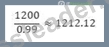
CAD in Canadian dollars. References: Canadian Investment Funds Course (CIFC) | IFSE Institute, Unit 8, Lesson 2
NEW QUESTION # 78
......
CIFC Exam Dumps Contains FREE Real Quesions from the Actual Exam: https://troytec.itpassleader.com/IFSE-Institute/CIFC-dumps-pass-exam.html