

(Dec-2024) Latest AZ-500 Dumps for Success in Actual Microsoft Certified
Changing the Concept of AZ-500 Exam Preparation 2024
IT Skills that are Strengthened with the Microsoft AZ-500 Exam
Professional IT certifications demonstrate mastery of cloud security technologies. Azure Security Architect certification is an important factor for people who work in the cloud based platform. Preparing for this exam will build up your skills for this area. Microsoft AZ-500 exam dumps and study guides will help you master this certification exam. Acquiring and maintaining the AZ-500 certification builds a strong foundation for lifelong learning. Appearing AZ-500 exam for certification is a very expensive investment. Materials for the AZ-500 exam are available at a very low price. Purchasing Azure Security Technologies (AZ-500) exam dumps is a fabulous investment.
Azure Snippets assists the IT professionals to deal with Microsoft Azure Platform. Testing tools for Azure Security Architect can help you master the important concepts for this certification exam. Easily manage Resources for Azure Security Architect with appropriate cloud security. List of the resources that are helpful for Azure Security Architect certification exam AZ-500.
NEW QUESTION # 236
You have an Azure Active Directory (Azure AD) tenant named Contoso.com and an Azure Kubernetes Service (AKS) cluster AKS1.
You discover that AKS1 cannot be accessed by using accounts from Contoso.com.
You need to ensure AKS1 can be accessed by using accounts from Contoso.com. The solution must minimize administrative effort.
What should you do first?
- A. From Azure recreate AKS1.
- B. From Azure AD, implement Azure AD Premium.
- C. From AKS1, upgrade the version of Kubernetes.
- D. From Azure AD, configure the User settings.
Answer: A
Explanation:
Explanation/Reference:
https://docs.microsoft.com/en-us/azure/aks/azure-ad-integration-cli
NEW QUESTION # 237
You have an Azure key vault.
You need to delegate administrative access to the key vault to meet the following requirements:
* Provide a user named User1 with the ability to set advanced access policies for the key vault.
* Provide a user named User2 with the ability to add and delete certificates in the key vault.
* Use the principle of least privilege.
What should you use to assign access to each user? To answer, select the appropriate options in the answer area.
NOTE: Each correct selection is worth one point.
Answer:
Explanation:
Explanation
User1: RBAC
RBAC is used as the Key Vault access control mechanism for the management plane. It would allow a user with the proper identity to:
* set Key Vault access policies
* create, read, update, and delete key vaults
* set Key Vault tags
Note: Role-based access control (RBAC) is a system that provides fine-grained access management of Azure resources. Using RBAC, you can segregate duties within your team and grant only the amount of access to users that they need to perform their jobs.
User2: A key vault access policy
A key vault access policy is the access control mechanism to get access to the key vault data plane. Key Vault access policies grant permissions separately to keys, secrets, and certificates.
References:
https://docs.microsoft.com/en-us/azure/key-vault/key-vault-secure-your-key-vault
NEW QUESTION # 238
You have a network security group (NSG) bound to an Azure subnet.
You run Get-AzureRmNetworkSecurityRuleConfig and receive the output shown in the following exhibit.
Use the drop-down menus to select the answer choice that completes each statement based on the information presented in the graphic.
NOTE: Each correct selection is worth one point.
Answer:
Explanation:
Explanation:
Box 1: able to connect to East US 2
The StorageEA2Allow has DestinationAddressPrefix {Storage/EastUS2}
Box 2: allowed
TCP Port 21 controls the FTP session. Contoso_FTP has SourceAddressPrefix {1.2.3.4/32} and DestinationAddressPrefix {10.0.0.5/32} Note:
The Get-AzureRmNetworkSecurityRuleConfig cmdlet gets a network security rule configuration for an Azure network security group.
Security rules in network security groups enable you to filter the type of network traffic that can flow in and out of virtual network subnets and network interfaces.
Reference:
https://docs.microsoft.com/en-us/azure/virtual-network/manage-network-security-group
NEW QUESTION # 239
You have an Azure subscription that contains an Azure SQL database named SQL1.
You plan to deploy a web app named App1.
You need to provide App1 with read and write access to SQL1. The solution must meet the following requirements:
Provide App1 with access to SQL1 without storing a password.
Use the principle of least privilege.
Minimize administrative effort.
Which type of account should App1 use to access SQL1, and which database roles should you assign to App1? To answer, select the appropriate options in the answer area.
NOTE: Each correct selection is worth one point.
Answer:
Explanation:
Reference:
https://docs.microsoft.com/en-us/azure/app-service/tutorial-connect-msi-sql-database?tabs=windowsclient%2Cdotnet
NEW QUESTION # 240
You have the Azure key vaults shown in the following table.
KV1 stores a secret named Secret1 and a key for a managed storage account named Key1.
You back up Secret1 and Key1.
To which key vaults can you restore each backup? To answer, select the appropriate options in the answer area.
NOTE: Each correct selection is worth one point.
Answer:
Explanation:
NEW QUESTION # 241
You need to deploy Microsoft Antimalware to meet the platform protection requirements.
What should you do? To answer, select the appropriate options in the answer area.
NOTE: Each correct selection is worth one point.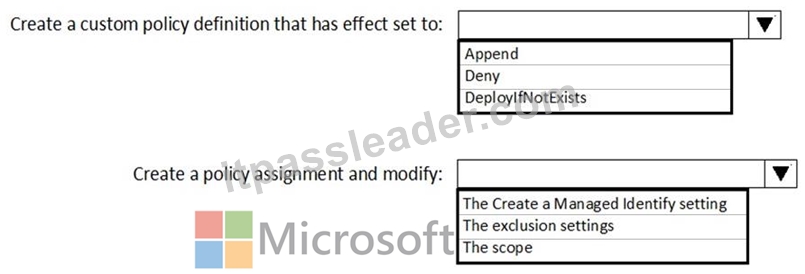
Answer:
Explanation:
NEW QUESTION # 242
You are configuring just in time (JIT) VM access to a set of Azure virtual machines.
You need to grant users PowerShell access to the virtual machine by using JIT VM access.
What should you configure? To answer, select the appropriate options in the answer area.
NOTE: Each correct selection is worth one point.
Answer:
Explanation:
NEW QUESTION # 243
: 2 HOTSPOT
Which virtual networks in Sub1 can User2 modify and delete in their current state? To answer, select the appropriate options in the answer area.
NOTE: Each correct selection is worth one point.
Answer:
Explanation:
Explanation
Box 1: VNET4 and VNET1 only
RG1 has only Delete lock, while there are no locks on RG4.
RG2 and RG3 both have Read-only locks.
Box 2: VNET4 only
There are no locks on RG4, while the other resource groups have either Delete or Read-only locks.
Note: As an administrator, you may need to lock a subscription, resource group, or resource to prevent other users in your organization from accidentally deleting or modifying critical resources. You can set the lock level to CanNotDelete or ReadOnly. In the portal, the locks are called Delete and Read-only respectively.
* CanNotDelete means authorized users can still read and modify a resource, but they can't delete the resource.
* ReadOnly means authorized users can read a resource, but they can't delete or update the resource.
Applying this lock is similar to restricting all authorized users to the permissions granted by the Reader role.
Scenario:
User2 is a Security administrator.
Sub1 contains six resource groups named RG1, RG2, RG3, RG4, RG5, and RG6.
User2 creates the virtual networks shown in the following table.
Sub1 contains the locks shown in the following table.
References:
https://docs.microsoft.com/en-us/azure/azure-resource-manager/resource-group-lock-resources
NEW QUESTION # 244
You have an Azure Active Directory (Azure AD) tenant that contains the users shown in the following table.
From Azure AD Privileged Identity Management (PIM), you configure the settings for the Security Administrator role as shown in the following exhibit.
From PIM, you assign the Security Administrator role to the following groups:
Group1: Active assignment type, permanently assigned
Group2: Eligible assignment type, permanently eligible
For each of the following statements, select Yes if the statement is true. Otherwise, select No.
NOTE: Each correct selection is worth one point.
Answer:
Explanation:
Reference:
https://docs.microsoft.com/en-us/azure/active-directory/privileged-identity-management/pim-configure
https://docs.microsoft.com/bs-cyrl-ba/azure/active-directory/privileged-identity-management/pim-resource-roles-configure-role-settings
NEW QUESTION # 245
Use the following login credentials as needed:
To enter your username, place your cursor in the Sign in box and click on the username below.
To enter your password, place your cursor in the Enter password box and click on the password below.
Azure Username: [email protected]
Azure Password: Ag1Bh9!#Bd
The following information is for technical support purposes only:
Lab Instance: 10598168


You need to perform a full malware scan every Sunday at 02:00 on a virtual machine named VM1 by using Microsoft Antimalware for Virtual Machines.
To complete this task, sign in to the Azure portal.
Answer:
Explanation:
See the explanation below.
Explanation
Deploy the Microsoft Antimalware Extension using the Azure Portal for single VM deployment
1. In Azure Portal, go to the Azure VM1's blade, navigate to the Extensions section and press Add.
2. Select the Microsoft Antimalware extension and press Create.
3. Fill the "Install extension" form as desired and press OK. Scheduled: EnableScan type: FullScan day:
Sunday
Reference:
https://www.e-apostolidis.gr/microsoft/azure/azure-vm-antimalware-extension-management/
NEW QUESTION # 246
You have an Azure Active Directory (Azure AD) tenant named contoso1812.onmicrosoft.com that contains the users shown in the following table.
You create an Azure Information Protection label named Label1. The Protection settings for Label1 are configured as shown in the exhibit. (Click the Exhibit tab.)
Label1 is applied to a file named File1.
For each of the following statements, select Yes if the statement is true, Otherwise, select No.
NOTE: Each correct selection is worth one point.
Answer:
Explanation:
NEW QUESTION # 247
You have an Azure subscription that contains the alerts shown in the following exhibit.
Use the drop-down menus to select the answer choice that completes each statement based on the information presented in the graphic.
NOTE: Each correct selection is worth one point.
Answer:
Explanation:
References:
https://docs.microsoft.com/en-us/azure/azure-monitor/platform/alerts-overview
NEW QUESTION # 248
You have a management group named Group1 that contains an Azure subscription named sub1. Sub1 has a subscription ID of 11111111-1234-1234-1234-1111111111.
You need to create a custom Azure role-based access control (RBAC) role that will delegate permissions to manage the tags on all the objects in Group1.
What should you include in the role definition of Role1? To answer, select the appropriate options in the answer area.
NOTE: Each correct selection is worth one point.
Answer:
Explanation:
Explanation:
Text, application Description automatically generated
Note: Assigning a custom RBAC role as the Management Group level is currently in preview only. So, for now the answer to the assignable scope is the subscription level.
Reference:
https://docs.microsoft.com/en-us/azure/role-based-access-control/resource-provider-operations
https://docs.microsoft.com/en-us/azure/role-based-access-control/custom-roles
https://docs.microsoft.com/en-us/azure/role-based-access-control/custom-roles-portal#step-5-assignable-scopes
NEW QUESTION # 249
SIMULATION
A user named Debbie has the Azure app installed on her mobile device.
You need to ensure that [email protected] is alerted when a resource lock is deleted.
To complete this task, sign in to the Azure portal.
- A. You need to configure an alert rule in Azure Monitor.
* Type Monitor into the search box and select Monitor from the search results.
* Click on Alerts.
* Click on +New Alert Rule.
* In the Scope section, click on the Select resource link.
* In the Filter by resource type box, type locks and select Management locks (locks) from the filtered results.
* Select the subscription then click the Done button.
* In the Condition section, click on the Select condition link.
* In the Notification type box, select the Email/SMS message/Push/Voice option.
* In the Email/SMS message/Push/Voice window, tick the Azure app Push Notifications checkbox and enter [email protected] in the Azure account email field.
* Click the OK button to close the window.
* Enter a name such as Debbie Mobile App in the notification name box.
* Click the Review & Create button then click the Create button to create the action group.
* Back in the Create alert rule window, in the Alert rule details section, enter a name such as Management lock deletion in the Alert rule name field.
* Click the Create alert rule button to create the alert rule. - B. You need to configure an alert rule in Azure Monitor.
* Type Monitor into the search box and select Monitor from the search results.
* Click on Alerts.
* Click on +New Alert Rule.
* In the Scope section, click on the Select resource link.
* In the Filter by resource type box, type locks and select Management locks (locks) from the filtered results.
* Select the subscription then click the Done button.
* In the Condition section, click on the Select condition link.
* Select the Delete management locks condition the click the Done button.
* In the Action group section, click on the Select action group link.
* Click the Create action group button to create a new action group.
* Give the group a name such as Debbie Mobile App (it doesn't matter what name you enter for the exam) then click the Next: Notifications > button.
* In the Notification type box, select the Email/SMS message/Push/Voice option.
* In the Email/SMS message/Push/Voice window, tick the Azure app Push Notifications checkbox and enter [email protected] in the Azure account email field.
* Click the OK button to close the window.
* Enter a name such as Debbie Mobile App in the notification name box.
* Click the Review & Create button then click the Create button to create the action group.
* Back in the Create alert rule window, in the Alert rule details section, enter a name such as Management lock deletion in the Alert rule name field.
* Click the Create alert rule button to create the alert rule. - C. You need to configure an alert rule in Azure Monitor.
* Type Monitor into the search box and select Monitor from the search results.
* Click on Alerts.
* Click on +New Alert Rule.
* In the Scope section, click on the Select resource link.
* In the Filter by resource type box, type locks and select Management locks (locks) from the filtered results.
* Select the subscription then click the Done button.
* In the Condition section, click on the Select condition link.
* Select the Delete management locks condition the click the Done button.
* In the Notification type box, select the Email/SMS message/Push/Voice option.
* In the Email/SMS message/Push/Voice window, tick the Azure app Push Notifications checkbox and enter [email protected] in the Azure account email field.
* Click the OK button to close the window.
* Enter a name such as Debbie Mobile App in the notification name box.
* Click the Review & Create button then click the Create button to create the action group.
* Back in the Create alert rule window, in the Alert rule details section, enter a name such as Management lock deletion in the Alert rule name field.
* Click the Create alert rule button to create the alert rule.
Answer: B
NEW QUESTION # 250
You have an Azure Active Directory (Azure AD) tenant that contains the users shown in the following table.
You create and enforce an Azure AD Identity Protection sign-in risk policy that has the following settings:
Assignments: Include Group1, exclude Group2
Conditions: Sign-in risk level: Medium and above
Access Allow access, Require multi-factor authentication
You need to identify what occurs when the users sign in to Azure AD.
What should you identify for each user? To answer, select the appropriate options in the answer area.
NOTE: Each correct selection is worth one point.
Answer:
Explanation:
Reference:
http://www.rebeladmin.com/2018/09/step-step-guide-configure-risk-based-azure-conditional-access-policies/
https://docs.microsoft.com/en-us/azure/active-directory/identity-protection/concept-identity-protection-policies
https://docs.microsoft.com/en-us/azure/active-directory/identity-protection/concept-identity-protection-risks
NEW QUESTION # 251
You have an Azure Active Directory (Azure AD) tenant named contoso.com. The tenant contains the users shown in the following table.
You configure an access review named Review1 as shown in the following exhibit.
Use the drop-down menus to select the answer choice that completes each statement based on the information presented in the graphic.
NOTE: Each correct selection is worth one point.
Answer:
Explanation:
Explanation
Box 1: User3 only
Use the Members (self) option to have the users review their own role assignments.
Box 2: User3 will receive a confirmation request
Use the Should reviewer not respond list to specify what happens for users that are not reviewed by the reviewer within the review period. This setting does not impact users who have been reviewed by the reviewers manually. If the final reviewer's decision is Deny, then the user's access will be removed.
No change - Leave user's access unchanged
Remove access - Remove user's access
Approve access - Approve user's access
Take recommendations - Take the system's recommendation on denying or approving the user's continued access References:
https://docs.microsoft.com/bs-latn-ba/azure/active-directory/privileged-identity-management/pim-how-to-start-se
NEW QUESTION # 252
Your network contains an on-premises Active Directory domain named adatum.com that syncs to Azure Active Directory (Azure AD).
The Azure AD tenant contains the users shown in the following table.
You configure the Authentication methods - Password Protection settings for adatum.com as shown in the following exhibit.
For each of the following statements, select Yes if the statement is true. Otherwise, select No.
NOTE: Each correct selection is worth one point.
Answer:
Explanation:
Reference:
https://docs.microsoft.com/en-us/azure/active-directory/authentication/howto-password-ban-bad-on-premises-deploy
https://docs.microsoft.com/en-us/azure/active-directory/authentication/concept-password-ban-bad
NEW QUESTION # 253
Note: The question is included in a number of questions that depicts the identical set-up. However, every question has a distinctive result. Establish if the solution satisfies the requirements.
Your company has an Active Directory forest with a single domain, named weylandindustries.com. They also have an Azure Active Directory (Azure AD) tenant with the same name.
You have been tasked with integrating Active Directory and the Azure AD tenant. You intend to deploy Azure AD Connect.
Your strategy for the integration must make sure that password policies and user logon limitations affect user accounts that are synced to the Azure AD tenant, and that the amount of necessary servers are reduced.
Solution: You recommend the use of federation with Active Directory Federation Services (AD FS).
Does the solution meet the goal?
- A. No
- B. Yes
Answer: A
Explanation:
Explanation
A federated authentication system relies on an external trusted system to authenticate users. Some companies want to reuse their existing federated system investment with their Azure AD hybrid identity solution. The maintenance and management of the federated system falls outside the control of Azure AD. It's up to the organization by using the federated system to make sure it's deployed securely and can handle the authentication load.
Reference:
https://docs.microsoft.com/en-us/azure/active-directory/hybrid/how-to-connect-pta
NEW QUESTION # 254
You have an Azure web app named WebApp1.
You upload a certificate to WebApp1.
You need to make the certificate accessible to the app code of WebApp1.
What should you do?
- A. Add a user-assigned managed identity to WebApp1.
- B. Configure the TLS/SSL binding for WebApp1.
- C. Enable system-assigned managed identity for the WebApp1.
- D. Add an app setting to the WebApp1 configuration.
Answer: D
Explanation:
Explanation/Reference:
https://docs.microsoft.com/en-us/azure/app-service/configure-ssl-certificate-in-code
NEW QUESTION # 255
......
AZ-500 Exam Crack Test Engine Dumps Training With 410 Questions: https://troytec.itpassleader.com/Microsoft/AZ-500-dumps-pass-exam.html